
Ancient Inventions is a new series paying homage to (very) early inventors, and the incredible tools and contraptions they developed. Some are relatively unknown, while others are household names, but all have played a fundamental role in shaping the modern world and the products we use today. Who knows, you may even happen on some vintage inspiration.

The idea of steam power may conjure images of Mississippi paddle boats and locomotives, but this quintessential technology came to life much earlier than you’d think. The first reference to steam power is actually made by the Roman author and engineer Vitruvius (c.80 BC – c.15AD), who writes about a “violent wind” created when water is heated in an enclosed vessel. However, the first practical device showcasing the tech was created by Hero (c.10–70 AD), a Greek engineer living in ancient Alexandria. Already a gifted teacher at the Library of Alexandria, Hero taught courses in physics, pneumatics and mechanics, and his studies involving steam inspired him to experiment with a mechanism that could harness it.
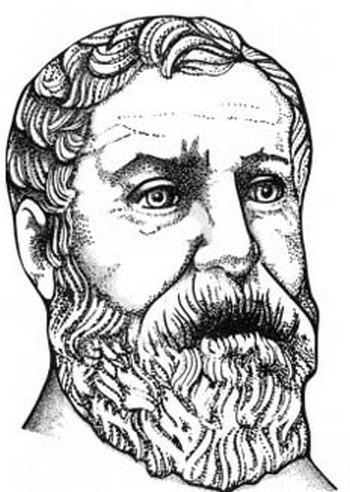
Hero of Alexandria
The result of Hero’s work was the aeolipile (named for Aeolus, the Greek wind god), a primitive steam engine that spun rapidly when heated. The device consisted of a hollow brass sphere suspended over a flame by an axle, with bent tubes protruding from either side. When filled with water and lit, steam would shoot from both tubes, causing the sphere to spin on its axis and generate torque. Moreover, as the rate of rotation increased, aerodynamic drag and friction increased as well, eventually canceling out the acceleration to maintain a steady speed.
Although his device was centuries ahead of its time, Hero’s engineering talent did not come with much creative vision. The aeolipile, despite being a working engine, was used primarily as a gimmick, a “wonder” to impress temple visitors, and was never applied to a practical function. Hero did experiment with designs for a steam-powered door to be installed in temples, but a prototype of this mechanism was never created. Passed off as a curiosity, Hero’s advancements in steam power would be forgotten for over 1000 years, before being rediscovered by the Turkish inventor Taqi al-Din in the 16th century (talk about a production delay). While Hero would go on to make impressive advancements in the fields of complex mechanics and power sources (Hero is credited with the first use of wind power as well), we can’t help but wonder what could have been, had he realized the potential of his creation.

