Archive for January, 2013

  • Mon, Jan 14 2013


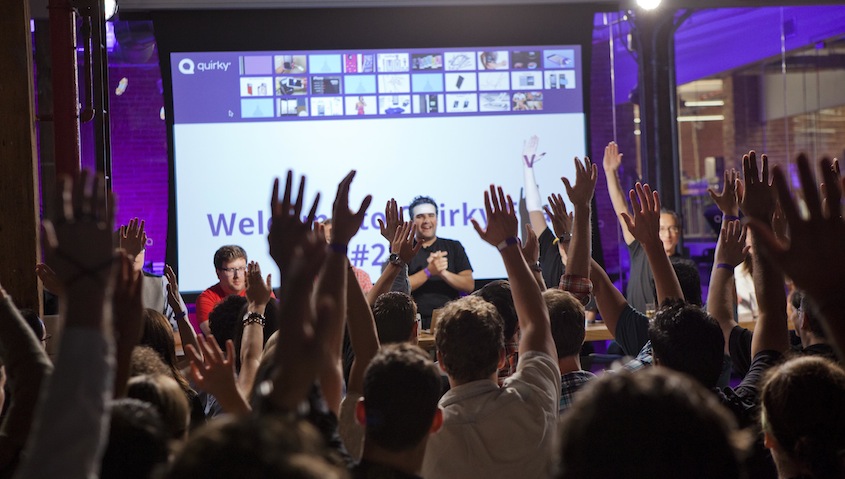
    If you weren’t there to bear witness, last week’s Feedback Friday introduced a new kind of discussion to the mix, one that we’re hoping will prove most beneficial to both the Quirky staff who are picking ideas, and the inventors who are submitting them. This new format is built around Quirky’s product categories: last week’s broadcast featured a successful discussion on the Fitness category, and this week, we’re shifting the focus to Accessories.

    As some of you may know, the Quirky staff searches through the site’s idea submissions in category-based groups, with individual staffers being assigned to groups according to interest and expertise. This week’s Feedback Friday broadcast will feature members of the Accessories group, who will provide a full breakdown of their thoughts on the category, pointing out which ideas they like, which ideas they see too often, and which ideas they’d like to see more of (to name a few topics of discussion). Viewers will also have the chance to ask questions through the chat, allowing you to pick the brains of the very people who look through the Accessory category each and every week. Whether you’ve submitted a dozen varied accessories in the past, or are just considering your first, this is definitely not a broadcast to miss.

    So, how can you get involved in this special symposium? It really couldn’t be easier. Simply head to the Quirky Live page at 3pm EST this Friday, and be ready with your Accessory-related questions! Alternatively, if you can’t make the actual broadcast, feel free to post your questions in the comments below. We’ll handle the rest.

  • Mon, Jan 14 2013

    During a 2003 interview with Rolling Stone magazine, the late Steve Jobs shared a particularly potent piece of advice passed on from his father, a mechanic and carpenter:

    “When you’re a carpenter making a beautiful chest of drawers, you’re not going to use a piece of plywood on the back, even though it faces the wall and nobody will ever see it. You’ll know it’s there, so you’re going to use a beautiful piece of wood on the back. For you to sleep well at night, the aesthetic, the quality, has to be carried all the way through.”

    This particular insight played a crucial role in shaping Job’s design process, perhaps more than any other. During his tenure as CEO of Apple, Jobs advocated and enforced a nearly fanatical attention to detail amongst Apple’s designers, demanding that every product component be masterfully crafted, regardless of its size or significance. He insisted on an exquisitely-etched Apple logo for Apple’s “Sunflower” iMac G4, in spite of the logo’s inconspicuous nature, and he regularly asked engineers to rework and refine the aesthetics of internal circuit boards, even though the components might never be seen by the consumer. While aesthetics are a key component of Apple’s design ethos, this fine-tuning was not only intended to impress consumers who might actually deconstruct an Apple device. Rather, Jobs firmly believed that a true craftsman had to respect every component of a design to truly respect the device, and that an emphasis on leaving no detail behind would ultimately lead to better products.

    Now, the Quirky development process is a collaborative one, so this advice should be taken with a grain of salt: no one expects you to map out every nook, cranny and circuit board before submitting your idea. However, when you are working on a concept sketch, it’s important to devote your attention to every part of the product —every button, handle and surface— and not just the parts that you feel are important. The main innovation of Thor may be in the double-bladed head, but Quirky’s design staff spent just as much time ensuring that the handle grip was both effective and ergonomic. The result is a product that provides an all-around exceptional experience: apply that same attention to each individual component of your next product design, and you may be pleasantly surprised by the result.

    Past Design Tips:
    Dieter Rams And The Ten Design Commandments
    Reflect On Your Work
    Know What’s Possible

  • Mon, Jan 14 2013

    Imants Caklais (A.K.A. Crreate), is not just the inventor of Vessel, he is also the genius behind Paper Landmarks, a line of paper scale model kits that allow you to recreate iconic landmarks from across the globe by hand. His ability to capture the majesty and romance of world-class architecture through scale models is incredibly inspiring, as is the innovative thinking that lead him to make a mass-market product out of his art. Paper Landmarks are selling like crazy on Etsy, Fab and at Paperlandmarks.com, but Imants was able to take a break from his busy model making to share some insights on the creative process, and the magical world of model making.

    Quirky: Thanks for agreeing to chat with us Imants! Let’s start off with the basics: where do you live? What do you love? What do you hate?

    Imants: I’m from and now live in Latvia, Europe, which is a small and developing but beautiful country. I studied architecture, so naturally I love everything connected with it, design and art in general. I love history, politics, traveling and coffee. I hate being late.

    Q: The Quirky community knows you by your handle: Crreate. What’s the story behind the double “r”?

    I: My nickname Crreate means that sometimes you need more than one “r” to get things done so that “C” could still stand for “creativity”.

    Q: How did you discover Quirky?

    I: More than 2 years ago I found Quirky through a blog post about the newest startups.

    Q: How did you become a designer of architectural scale models?

    I: Well, being educated as an architect (I got my M.Arch degree from Riga Technical University) and working for a long time as a designer at the largest packaging design company in the region, starting Paper Landmarks was inevitable. I made a lot of architectural scale models while studying. For clarity, architectural models and my kits are not exactly the same, though both feature architecture in scale. Architectural models can be made from any available material, most usually paper, cardboard, foam board or corrugated board (but also plastic, wood, metal etc.). However, the main difference is that architectural scale models are made for a presentation, usually in one copy, so there is not a lot of emphasis on keeping production costs low in terms of making more rational layout of the parts on the sheet, or thinking how to make the process of assembly clearer and simpler. While architectural models could be more detailed than paper models (my kits), I find it more delightful to make a mass-reproducable design than just a one-off version.

    Q: What was the first Paper Landmark you made?

    I: The first was the Eiffel Tower, naturally. I say naturally because it’s the most recognizable landmark on Earth. It’s also a very tricky one—with a lot of intricate cutouts and details. My challenge was to make a reproducible design which could be mass-produced on a die-cut machine. There are certain limitations to how small the details could be when making the die-cut forms, and at first look it seemed like it wasn’t technically possible to make all the cutouts needed to create a remarkable design. However, I found a solution to that problem. Instead of making tiny cutouts in a single layer, I made a design with overlapping layers of paper: each could have larger cutouts that, when put together, formed a delicate pattern that also strengthened the structure by using both layers of paper. When you are at the base of the real Eiffel Tower in Paris, you can find a lot of cheap metal or plastic cast replicas that don’t capture the magic of recreating the structure yourself from flat pre-cut details.

    Q: How do you chose a landmark to recreate?

    I: If it’s not a commissioned work, then I choose based on what landmark I feel personally connected to, or what might be popular among my customers. Of course, there are some landmarks that I already know will look better than others when made in paper. What the general public considers a landmark to look like and what the model shows could be two different things. It’s obvious why—you look at the spires of the skyscrapers from street level, so you have only that beautiful recognizable image in your mind. When reproducing this architecture in scale, I need to include the entire volume of the building, which is surprisingly different from that iconic image most people have in their heads. The Empire State Building or Villa Savoye look good from any point, but there are some buildings that look awesome just from that one iconic point of view. The other thing I found when working on the models is that you’d better understand the architecture itself when putting it all together. I use all the blueprints available and study the building throughout. It’s not rare to find a detail in the original architectural drawings that indicates that it can’t be done that way, and that there is an error with that drawing. When I check the photos of the actual building, I often find that yes, the plan was obviously corrected later and built accordingly.

    Q: What’s your favorite way to procrastinate?

    I: I’ve always found that the most productive ideas come while doing something else, like surfing the internet, cleaning, or preparing food. The rush that follows is good for focusing on getting the job done, but it’s also the details that result in quality, so I try to do as much as possible in one phase while leaving some time for double-checking with fresh eyes.

    Q: What is your workspace like?

    I: Since I create my designs on a computer, that’s my most important workspace, but of course, I also have a table covered with a cutting mat for testing details, gluing prototypes and just hand drawing and writing. I can still, somehow, find a place for my coffee mug there.

    Q: What tool could you never live without?

    I: The most simple one, a pen. I’m drawing or writing all the time so I need that tool for sure.

    Q: What’s your ideal playlist for working?

    I: Most of time I listen to nothing as it helps me focus. But then, I take some breaks with deeply inspirational music, like Al Di Meola, classics, or 60s music. Click here for one of my incomplete online playlists.

    Q: Where do you go when you need some inspiration?

    I: I love to travel and actually get a special feeling when working on the landmarks I’ve visited before or vice versa. Any particular building  is not only a masterpiece of architecture for me, but also a bit of history. I read a lot of books and articles on history because you can’t understand what’s really going on in the world without knowing the history.

    Q: You must have had some landmark failures along the way. Tell us about them.

    I: Failures? Well, luckily there haven’t been any major ones, as I’m cautious before investing in a new product, and think everything over seven times. Everything can go wrong, so you need to check your own design work, control the in-house and outsourced production and delivery process, and deal with vendors and buyers.

    Q: What was the hardest part about bringing Paper Landmarks to market?

    I: Well, I naturally have several obstacles based on the distance between where I’m living and where most of my customers are: languages, currencies, borders, shipping time/costs, time zones, and cultural differences. I need to overcome all of these to make my business successful. Now it’s easier than 10+ years ago when I started—there was no PayPal in my country (Latvia wasn’t even a part of the EU at that time), no developed social media, no trackable shipping method, and no track record of my own.

    Q: What’s the next project you have in the works?

    I: I’m working simultaneously on several projects, for example, on a big museum model, and I also have plans for redesigning several previously made models.

    Q: If you could give other Quirky members one piece of advice, what would it be?

    I: Being an endless optimist, I look at Quirky as an opportunity, so no matter how you feel about one thing or another that’s going on there, look at this as a glass half full and hopefully it will be full for you one day! Now, drink wisely.

    Now it’s time for you to ask Imants all the burning questions you have for him! Join us for a community interview with Imants via Twitter on Wednesday, January 16th, from 3 to 4 pm EST. To participate, simply tweet your question between 3 and 4pm EST to @paperlandmarks using the hashtag #QTalk.

  • Mon, Jan 14 2013

    If you weren’t able to tune in to Quirky Live on Thursday, you missed out on quite a show, as last week’s Eval featured some of the most exciting discussions and product pitches we’ve seen in many moons. In between heated debates and killer one-liners from Quirky’s Head of Profoundness, three ideas were selected to undergo Quirky’s communal development process, in the hopes of making the move from sketching board to store shelves. You can watch the full recording of the event at the bottom of this post, but for those of you on a schedule, here is a rundown of Quirky’s newest inventors:

    As a long-time tinkerer and inventor, Steve Balassone knows his way around a product pitch, which gave him a compelling advantage when his idea for a better muffin tin was brought before the crowd at Eval. Through a well-produced video, Balassone demonstrated his product’s ability to effortlessly pop muffins out of their molds, and he backed up the hype with a working prototype to boot. Unsurprisingly, the submission received a resoundingly strong vote, and will soon be joining Batch, Nibble, and Twisted Sifter as part of Quirky’s growing line of baking products.

    With four Quirky products already under their belts, inventor duo Jenson is right at home at Eval, and last week’s showing didn’t see them losing any steam. Their product, the Butter Twister, had some competition on the market, but a clever design and portion control functionality helped to distinguish it from the crowd, earning a vote of confidence from culinary enthusiasts in the office and on the online chat. While the Quirky engineering team will have to buckle down to refine the product’s portion control element, this product will be in welcome company when it reaches store shelves.

    The final selection at this week’s Eval was a bit of an outlier, as the concept was moved to Eval with a few provisos. Intrigued by the potential of Laura Doty‘s Banana Bonnet, the Quirky staff was eager to move forward with its development, but wanted to conduct a few tests before fully embracing the concept. Under these conditions, the product was selected as an “Explore”, and the design staff is now conducting an experiment to test just how much a bonnet can slow a banana’s ripening process. We’ll have the results by the end of the week, but for now, we’ll take the existence of similar DIY solutions as a promising sign!


    Video streaming by Ustream

  • Fri, Jan 11 2013

    Hello again Quirky community! This was our first week back after the Quirky blackout – a new way of working we announced in late December – and boy were we happy to see all of you again. Though we took a break from operations for a week, we jumped right back into the saddle when we returned to the office on Monday. Hopefully you were able to join us over the last seven days, but even if you couldn’t we’ve got the weekly recap here to get you all caught up.

    The press world kicked off a very Quirky new year with coverage of the company and our products across numerous outlets. Thrillist wrote pieces on Pen Zen and Vine, and Popular Science gave a shoutout to the much anticipated Cube Tube in their 2012 home innovations roundup. New York magazine wrote a full page piece on Pluck, which we Tweeted on Monday, and ChipChick covered the egg separator on Wednesday. Hot on the heels of our most viral Facebook post ever, LikeCool.com covered Kepler’s Kite Kit in a post, and Holycool.net covered not one, not two, but three Quirky kitchen products in their 8 product roundup of kitchen tools. Finally, on Thursday Business Insider ran a piece on 16 startups worth leaving your current job for. Guess who was on the list? After you finish reading, don’t forget to check out our careers page!

    Being an invention machine and all, Quirky was firing all cylinders on the product front this week, with 16 development phases, one new launch to the shop, a “we’re making this” announcement, and three product launches to the Upcoming page. The No Spill Measuring Cup, Mini Earbud Clip, and Honeycomb Organizer each had Naming, Tagline, and CMF phases, while a CMF phase was launched for the Thumbtack Spring, a Concept phase opened for the Ultimate Summer Beach Bag, and the Shower Clips went through Research and Community Design phases. On Tuesday we launched Sandables to the Upcoming page and the iPower Stand moved into the Refine Phase. Wednesday came with the announcement that we are making Twisted Sifter and the launch of the Suction Cup Hooks CMF phases, and we were happy to welcome Scoop to the Quirky shop. We launched Memo to the Upcoming page on Thursday and opened a Research phase for the Vehicle Cleaning Tool, and on Friday we wrapped up the week with the launch of Roadshow.

    Our content team started the week off with a Monday design tip focused on the famous German industrial designer, Dieter Rams’ 10 design commandments. One important take away: good design keeps things simple. We that followed with an announcement that Verizon is the latest retailer to carry Quirky iPhone 5 cases, as well as a sneak peek of this week’s fitness focused Feedback Friday, which you can watch in full below. On Tuesday we shared our insightful interview with Pen Zen inventor Edwin van de Bospoort, and on Wednesday we introduced you to the newest addition to the Quirky Community Team, Jessica Gray. Also on Wednesday, Baron wrote a piece on four unconventional innovations in fitness products in anticipation of Feedback Friday, and we brainstormed Shower Clips and the iPad Portable Speakers Stand. On Thursday Paula wrote a piece on the history of miniature animals, and on Friday we discussed some of the quirkiest products shown at the Consumer Electronics Show in Las Vegas, where our sales team and Ben have been all week. Finally, if you haven’t heard already, community member Paulette Jaques launched a new community contest on Friday to design a tote bag. The contest ends on Sunday, so be sure to get your designs in ASAP!

    And there you have it: week one of 2013 for Quirky and the community. We may have been out for a few days, but as you can see above we haven’t missed a beat. If we left anything out, please let us know in the comments below. Otherwise, have an restful and relaxing weekend, and enjoy the recordings of Eval and Feedback Friday below. We’ll see you again on Monday.

    Eval:


    Video streaming by Ustream

    Feedback Friday:


    Video streaming by Ustream

  • Fri, Jan 11 2013

    For the past four days, the Quirky team has been hitting the floor at the annual Consumer Electronics Show (CES), the year’s biggest and most blustery technology trade show. Tech brands and design firms from around the world converged to share the newest fruits of their research, presenting everything from cutting-edge cell phones to smart police cruisers. With so many brands presenting such a wide variety of tech, it would be impossible to cover every noteworthy innovation, but here are a few of the cool and curious products that were unveiled at this year’s CES. While some may not end up making it to market, all are guaranteed to at least make an impression.

    The Queen’s University PaperTab Tablet

    One of the most impressive products unveiled at this year’s CES is the PaperTab tablet, collaboratively developed by Queen’s University, Intel, and the UK design firm Plastic Logic. Each 10.7 inch tablet is designed to look and feel like a sheet of paper, featuring a flexible touchscreen that’s capable of displaying documents, images and even videos. While most current tablets are intended to run multiple applications at once, the PaperTab pursues a markedly different method. Each tablet runs one application at a time, and users are able to coordinate up to 10 tablets at once, effortlessly transferring documents from one tablet to another with a simple touch. Multiple tablets can also be used in unison: for example, two tablets can be combined to display one image in greater resolution. While commercial application of the tech may be 5-10 years away, we predict that this kind of digital tech will soon change the way that consumers use and manipulate physical documents.


    3D Systems CubeX Printer

    With the upcoming release of the Replicator 2X, MakerBot is poised to continue its domination of the consumer-level 3D printer market. However, the boys and girls at the 3D Systems design lab may have something to say about that. The brand’s newest printer, the CubeX, may qualify as the most versatile consumer printer on the market, beating out the newest MakerBot in several key categories. For one thing, the build area is dramatically larger, measuring 10.8 x 10.45 x 9.5 inches against the Replicator 2′s 11.2 x 6 x 6.1 inch area. CubeX models are also capable of printing in three colors, whereas the Replicator 2X can only print in two. However, the CubeX’s biggest distinction is likely  its ability to print in both ABS and PLA plastics, the two most common materials for desktop printers. Since every other consumer printer can only print in a single plastic, with a maximum of 2 colors, the CubeX has proven has proven itself to be quite the talent, with a starting price of $2,499 to boot. It’s okay, we’re drooling too.


    InTouch Health RP-VITA Medical Robot

    We might be biased towards robotics in general, but we’re geeking out over the latest robot from InTouch Health, aptly named the RP-VITA. Designed to help doctors monitor their patients remotely, the RP-VITA is the first medical robot that can move and navigate autonomously, thanks to built-in mapping software and obstacle sensors. A patient need only press a button, and the robot will be able to reach their bedside from any location in the hospital, entirely on its own. With a built-in communication monitor, and an iPad user interface for doctors, the RP-VITA and similar robots may soon change the way we find and visit doctors, allowing specialists to work with any patient, regardless of time and geographic location.


    Hapi Labs HapiFork

    Developed by health brand Hapi Labs, the HapiFork may be one of the more curious products to be revealed at this year’s CES, but it nevertheless addresses a rather serious problem: the nation’s growing struggle against obesity. The utensil features an integrated accelerometer that measures how fast a user eats, tracking the number and speed of bites taken. If an eager diner tries to take more than one bite every 10 seconds, the fork will vibrate, gently reminding you to slow down. With fast eating and under-chewing being linked to a number of health problems, such as weight gain and acid reflux, the fork’s theoretical value is self evident. The device can also link up with an online service that tracks your eating habits (a mobile app is in development), and compares them to those of your friends. While the ultimate impact of this product is still up in the air, it’s still heartening to see brands develop creative solutions for this very pervasive problem.


    Neurowear Necomimi Ears

    We did say “quirky”, didn’t we? These electronic cat years by tech company Neurowear are intended to serve as an alternative communication tool, moving back and forth in accordance with the wearer’s brain waves. If the wearer is concentrating intently on something, the ears will wiggle and stand up, while a relaxed brain will cause the ears to lie down. In a real world setting, the result is a dynamic new organ that twitches to and fro as the wearer lapses in and out of conversation. While the actually usefulness of the tech is questionable (if we’re bored at a party, we don’t want people to know it), the Necomimi is still an interesting step forward in neural tech and alternative communication, opening the door for more impactful innovations to come.

  • Fri, Jan 11 2013

    Nowadays, children use tablets just as much as adults, but precious few accessories are designed with their needs in mind. That was the thought behind Roadshow, a bag made especially for Apple’s youngest in-crowd. On adventures and field trips, it serves as a normal messenger bag, with a specialized pocket for an iPad, Kindle Fire, or any other tablet. However, on long car rides, kids can whip out the viewing sleeve and clip it to the back of a headrest, turning it into a mobile media station on the fly. The entire bag can also be clipped to the headrest for easy storage. If you’re a parent who’s logged 100+ hours of “I Spy”, this one’s a no-brainer.

    A busy mother of two, inventor Melissa Brown came up with an idea for a multi-tasking messenger bag, which would allow her kids to watch movies on an iPad while riding in the car. After winning over the crowd at Eval, the idea was refined by 408 community influencers, and can now be perused (and priced) in Quirky’s Upcoming section.

    Features:
    – Messenger bag with 2 exterior zip pockets
    – Removable viewing sleeve for an iPad or other tablet
    – Adjustable shoulder strap
    – Sleeve can be clipped to the back of a headrest for in-car movies and reading
    – Bag can be clipped to a headrest for easy storage

    Materials:
    – Nylon
    – Polypropylene
    – Cotton webbing

    Dimensions:
    – 356mm W x 254mm H x 76mm D

    Price, qty and features subject to change during production process.

  • Thu, Jan 10 2013

    They say good things come in small packages. After all, how would we survive without miniature versions of our favorite things, like marshmallows, golf, and even Pivot Power?

    However, you might be surprised to learn that the existence of minis isn’t limited to inanimate objects: they’ve crept up in the world of pets as well. While the motivations behind miniature products are mostly self-evident, the how and why behind mini animals is often unclear. Most were bred down from traditional sizes of their species, and scientists have linked the size variation of dog breeds to a particular gene. However, when it comes to the miniaturization of other species, and the ever-shrinking stature of existing breeds, the science is a little less clear.

    Whether you love them or find them terrifying, tiny critters are here to stay. Here’s a look at some micro varieties of our four-legged friends, and the curious innovations that brought them to life. Who knows, they may qualify as mankind’s strangest (and cutest) invention.

    Toy Poodles

    Even smaller than their ancestor, the miniature poodle, these little pups are quite intelligent. Toy poodles are thought to have originated in Europe sometime before the 15th century. It is believed that the poodle breed was made even smaller so that they could serve as truffle snuffers in Europe. They were also popular with King Louis XIV of France, as a symbol of fashion and social standing.


    Napoleon Cats

    Named after Monsieur Bonaparte as a nod to his short stature, these kitties hopefully didn’t inherit his complex as well. The breed debuted less than 20 years ago as a result of mating Persian cats with the Munchkin variety. Ironically, the former Emperor of France might not be thrilled that these playful pusses were named after him. Although the general was a force to be reckoned with on the battlefield, he had a phobia of felines.


    Tea Cup Pigs

    Miniature pigs have been around for a while. Although they have become popular as pets in recent years, this special variety was originally bred for research on organ transplants. The Vietnamese Potbelly Pig is another breed that has served as pets for decades, but they have caused woes for many apartment and small home dwellers, as these porkers start off small, but can grow to weigh as much as 200 lbs when they reach adulthood. The Tea Cup variety hit the scene more recently, and typically weighs between 40 and 60 lbs at most.


    Miniature Horses

    Even smaller than ponies, miniature horses have a variety of sub-breeds and typically weigh under 100 lbs. Rumor has it they were originally bred small so as to make suitable pets for the children of European royal families. These cuties are helpful too, as miniature horses can be trained as guides for the visually impaired. These pint-sized hoofers can live upwards of 35 years, so you should be comfortable with a commitment if you’re thinking of getting one as a pet.


    Pygmy Hippos

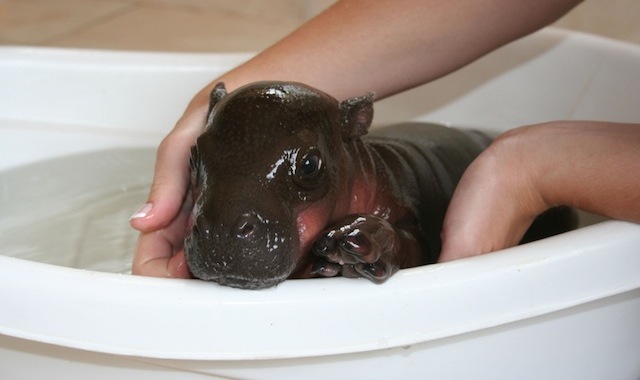
    Okay, so these little ones aren’t typically kept as pets, but they’re still stinking adorable. They share most of the same features with their larger relatives, but the pygmy hippo is about a quarter of the size of the standard hippopotamus (unfortunately, the one pictured above is still young). Little is known about how they came into existence: the general theory is that they naturally evolved from the common hippopotamus. Although most of these animals dwell in the wild, or in zoos and preserves, there was one famous exception. In 1927, Billy was presented as a gift to animal lover and U.S. president Calvin Coolidge.

    While miniature breeds are cute in their Polly-Pocket-sized stature, there is also something intriguing about larger breeds of traditionally small animals. Darryl and I really want to start a rooftop farm in the city that would feature Flemish Giants. Anyone interested?

  • Thu, Jan 10 2013

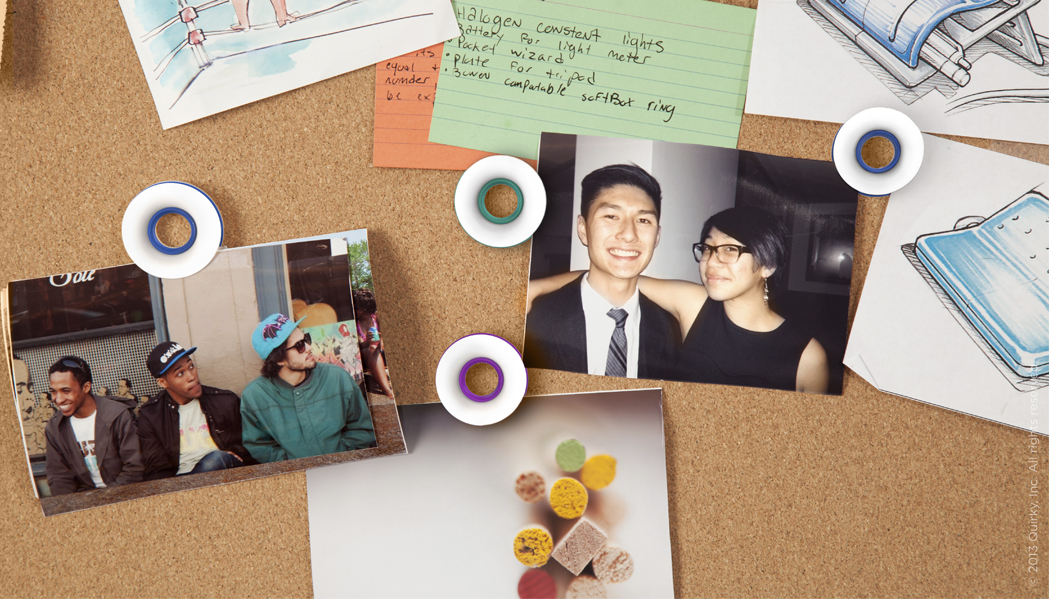
    Thumb tacks are great for pinning up reminders and useful information, but they inevitably damage whatever you are pinning. This is why Quirky made Memo, a mind bogglingly simple solution that’ll leave you wondering “why didn’t I think of that?” Like any tacks, each one can be pinned to a wall or cork board, but Memo has the added benefit of a rubber clip to hold papers and pictures without damaging them with holes. The papers are pinched between the plastic base and the clip to hold them securely, and the two metal tacks on the back keep Memo from rotating in the wall.

    When we launched our “Simple Solutions for Everyday Problems” brief in September thousands of brilliantly simple inventions were submitted for our consideration. Brent McDowell’s thumbtack with a spring was one of our favorites and after some design tweaks, Memo was born. You can check it out for yourself and help us determine the perfect price on the Upcoming page today.

    Features:
    – Clip form for securing papers, business cards, or pictures without puncturing them
    – Dual pin back keeps Memo secure and prevents rotation.
    – 5 per pack

    Materials:
    – Plastic base
    – Rubber clip
    – Metal tacks

    Dimensions:
    – 42mm x 42mm x 18mm

    Price, qty and features subject to change during production process.

  • Thu, Jan 10 2013

    If you missed the live broadcast we won’t leave you in the dark, here are the highlights and footage to bring you up to speed:

    Product 474: Shower Clips

    Product 521: iPad Portable Speaker Stand

    And for your viewing pleasure, the full recording of the live brainstorm:


    Video streaming by Ustream

    Be sure to share your reactions to this week’s brainstorm in the comments section below.

Page 1 of 212»