Archive for July, 2012

  • Wed, Jul 11 2012

    I’ve lived in New York City my entire life (save for four years of exile in Vermont for university) and for most of my decades the High Line was a weird abandoned rail project. In the 1930s, the city built an elevated railway through the middle of a stretch of downtown blocks. It wasn’t built above any streets but, rather, ran mid-block between and sometimes through the buildings. For most of my life it was a monstrosity I passed when traveling up the West Side Highway.

    When asked what to do with an abandoned elevated railway, most people — myself included — would answer, “Tear it down.” But two local residents, Joshua David and Robert Hammond, had a better idea: make it into a park.

    I walk under the High Line every day on my way to work at Quirky HQ. I always climb the six flights of steps and spend a couple of minutes up there in quiet contemplation before entering the fray and spending the next dozen hours serving the world’s biggest client: everybody. And every day, I’m awestruck by the High Line and by David and Hammond’s vision. I would have torn down what is today one of the most breathtaking public spaces in the known universe.

    The one problem I’ve always had with the High Line is that it is usually so crowded. But now that I’m there at about 7:30 each morning, I have the place mostly to myself.

    For a brief history of the High Line, check out the Friends of the High Line site.

  • Tue, Jul 10 2012

    Two of the world’s most influential thinkers and inventors were not only competitors, but bitter enemies. From their aptly named “War of Currents”, to rumored battles over a coveted Nobel Prize in physics, Thomas Edison and Nikola Tesla were titanic rivals for much of their careers.

    Their feud began in 1885 after Tesla relocated from Paris by way of Budapest to the US. He had been in Paris for three years prior working for the Continental Edison Company, where he designed improvements to electrical equipment invented by Edison. In 1884 Telsa traveled to New York city with a letter of recommendation for Thomas Edison from his former employer, Charles Batchelor, who supposedly equated the skills of the two inventors in his note. Though Edison hired Tesla to be an electrical engineer for his Edison Machine Works, he famously stated that while the young inventor’s ideas were splendid, they were utterly impractical. Despite Edison’s patronising attitude towards him, Tesla’s technical aptitude and knack for solving problems eventually led him to take on the mammoth task of redesigning the company’s direct current generators, which were literally the engines of the Edison’s colossal financial success. For accomplishing this task, Edison remarked that he would give Tesla $50,000 (about $1.1 million in today’s dollar), but after months of successful work he reneged, claiming that he was only joking. Humiliated, Tesla resigned shortly after and dedicated his time to developing his competing Alternating Current (AC) polyphase system.

    George Westinghouse

    After failing to keep his own company afloat, Tesla filed for seven U.S. patents in the fields of polyphase AC motors and power transmission between 1886 and 1887. Pittsburgh industrialist George Westinghouse, who had recently become interested in introducing alternating current to the United States, heard about Tesla’s invention and made an offer to purchase the his patents for $60,000, stock in the Westinghouse Corporation, and royalties amounting to $2.50 per horsepower of electrical capacity. Mired by financial trouble after leaving the Edison Machine Works, Tesla jumped at this opportunity and promptly invested the bulk of his newfound wealth on a new laboratory so he could continue inventing.

    Thus started the “War of Currents” between Westinghouse’s AC and Edison’s DC businesses. By the 1890s, the two industrialists were embroiled in full scale corporate warfare. Edison began issuing pamphlets warning the American public about the dangers of alternating-current and he hired Harold P. Brown to develop the first electric chair to demonstrate how deadly the current was. Together, Edison and Brown electrocuted and killed many animals while testing prototypes for the chair, going so far as to hold public executions for the Press  to ensure AC current was associated with electrocution.

    Columbian Exposition 1893

    Though the conflict over the dominant electrical current was primarily fought between Edison and Westinghouse, Edison’s attempts to bury Tesla’s most important invention stung the Serbian inventor and further entrenched his mistrust of his former employer. The animosity between the two men ran so deep that it is believed it prevented either of them receiving the 1915 Nobel Prize for physics that they were they were both nominated to share. Ultimately it was Tesla who had the last laugh. From the moment hundreds of thousands of AC-powered lightbulbs were lit at the Columbian Exposition in Chicago in 1893, alternating current devices became increasingly common place. Today DC power occupies only a small portion of the electrical space, while Tesla’s invention as the undisputed champion.

  • Tue, Jul 10 2012

    Here’s hoping that you guys have been catching up on Sesame Street, because this week’s brainstorm is all about the kids! The two new topics that will be discussed this Wednesday (6pm EST) are:

    - Children’s Cutlery Set

    - Word Builder Blocks

    If you’re new to brainstorms, allow us to explain. Every week, QDS blows a few product ideas wide open to kick off the design process. You can take part in that. Here’s how:

    1. Topics are posted above. In your wildest dreams, what would be the perfect way to make that product? What should it do, and what problems should it prevent? It’s a brainstorm, so anything goes.

    2. Visit the QuirkyLive Channel at 6pm ET on Wed. Log in on Ustream and throw ideas at us in the live chat.

    3. Can’t join the live brainstorm? Be sure to add your comments here before the start time, and we’ll have them in mind.

  • Tue, Jul 10 2012

    Nikola Tesla was a man of many homes. Though born in the Serbian village of Smiljan, then part of the Austrian Empire, he spent his early years studying in cities across Eastern Europe, and later worked for the Continential Edison Company out of Paris, France. However, Tesla’s life would be forever changed on June 6th, 1884, when he arrived by boat in the city of New York (appropriately, with only a few pennies and a letter of recommendation). It was here that Tesla would cultivate his most significant research, and where he would spend the vast majority of his career, until his death in 1943.

    Today, New York City is a very different city from the one Tesla first saw off a steamer’s bow: the price of bread has risen fifty-fold, and the immigrant tenements that filled Manhattan have since been replaced by boutiques and luxury condos. However, the prodigy from Serbia made an indelible mark on the city throughout his lifetime, and the evidence of his life and work can still be seen throughout Manhattan. For those intrepid enough to take a tour, we’ve listed some of the most notable locations below.

    The Fifth Avenue Lab (33-35 South 5th Avenue)
    One of Tesla’s most prominent workspaces, this laboratory on South 5th Avenue (now West Broadway) became Tesla’s primary workshop in 1890, taking up the entire fourth floor of the six-story structure. Here, Tesla conducted many of his most important electromagnetic experiments, including much of his earliest work on Tesla coils. The lab was lit by a series of wireless florescent bulbs, developed through Tesla’s research in wireless power transmission, that were said to illuminate the space with a brilliant light. The lab was also the setting for many of Tesla’s early demonstrations, and famous friends such as the author Mark Twain were known to be frequent visitors.

    Unfortunately, the Fifth Avenue laboratory suffered a cruel stroke of fate in 1895: a fire in the building’s basement spread to consume the entire building, destroying the vast collection of models, plans, tools, data and photographs that Tesla had accumulated. While Tesla’s work went on in spite of the disaster, the blow was a heavy one, and when asked by the New York Times for his reaction, the inventor simply replied: “I am in too much grief to talk. What can I say?”

    Mark Twain during a visit to Tesla’s South 5th Avenue Lab

    The Houston Street Lab (46 E. Houston Street)
    While the loss of Tesla’s South 5th Avenue lab was a crushing blow, the tireless inventor was quick to recover, and soon established a new laboratory at 46 E. Houston Street, a building he shared with a rowdy hotel and theater. Here, he resumed his experiments with gusto, focusing on the study of electrical transformers and oscillation. It was in this lab, amongst hulking conductors and test equipment, that one of the most infamous incidents of Tesla’s career occurred: in 1898, when experimenting with a steam-powered mechanical oscillator, Tesla accidentally replicated the resonance frequency of the surrounding buildings, which reportedly caused the structures to tremble dangerously. Despite the minute size of Tesla’s device (it is recorded as being only 7 inches long), the speed of oscillation continued to increase, and Tesla realized that the continuing process could potentially level the building if it wasn’t stalled in time. As a final resort, Tesla smashed the device with a hammer, just as a squad of policemen arrived to investigate the incident. The structure itself was not permanently damaged, but residents several blocks away were said to have felt the tremors. Today, the building that housed Tesla’s lab has been replaced by high-priced  condos, with SoHo Billiards in residence on the ground floor, but if you find yourself walking by the block, don’t be surprised if you feel a little shake.

    Tesla’s Houston St. Lab, illuminated by wireless lights

    Radio Wave Building (49 West 27th Street)
    Formerly the Gerlach Hotel, the Radio Wave Building was renamed in honor of Tesla and his research. It was here, before the turn of the century, that Tesla conducted his experiments on the behavior of radio waves, laying the foundation for his work in radio signals and wireless transmission. While he soon moved on to work in other facilities, the impact and importance of his work has remained fundamental to the building’s identity. In 1977, a commemorative plaque was installed on the building to acknowledge the role it played in Tesla’s work, which can still be seen from the street today.

    The Radio Wave Building as it appears today

    The New Yorker Hotel (481 8th Avenue)
    While Tesla remained a prominent public figure for most of his life, he was not an inventor that was wired for prosperity, and a string of legal battles, underfunded projects, and other misfortunes left Tesla destitute towards the end of his career. In 1933, the impoverished scientist moved into Room 3327 on the 33rd floor of the New Yorker Hotel, where he would live for his remaining 10 years. As the mental and emotional strains of his career wore him down, Tesla grew increasingly distant and senile, rarely speaking to the press and spending long hours feeding and nursing pigeons in a nearby park. He died in his room on January 7th, 1943, suffering from heart thrombus. A commemorative plaque was designed for the building in 1977, but complications prevented its unveiling until 2001: the plaque can be seen to this day on the 34th-street side of the building.

    The commemorative plaque installed at the New Yorker Hotel, acknowledging Tesla’s work


    Sources:
    About.com
    Tesla Society
    The Tenement Museum

  • Tue, Jul 10 2012

    The Tesla Coil

    By Nathaniel at 2:00 pm

    Nikola Tesla invented the the Tesla Coil near the end of the 19th century, first introducing it publicly in US patent No. 454,622 for use in new, more efficient lighting systems. It came out of some of his earliest research into alternating currents and was used in all manners of experiments by Tesla, including investigations of x-ray generation, electrotherapy, and wireless transmission of electrical energy.  

    A Tesla Coil is an air-core resonant transformer capable of producing enormous voltages and discharges of electricity. While the conventional transformer method generates voltage through a primary/secondary turns ratio, the high voltages produced by Tesla coils are achieved through resonant rise. Designed as a tool for dispersing nearly unlimited amounts of electricity, Tesla hoped to use his invention to transmit wireless power and information throughout the world.

    A Tesla coil consists of a high voltage transformer, capacitor, coil inductor, and adjustable spark-gap electrodes, and works through the oscillation of the capacitor and coil inductor. For oscillation to occur, the capacitor is first charged by a high voltage transformer to a voltage ranging from 10,000 to millions of volts, depending on the size of the device. Eventually the voltage reaches the breakdown voltage of the spark gap, causing the air in the gap to break down as an insulator and the spark gap to begin conducting. Once conduction starts, the spark gap connects the capacitor in parallel with the coil inductor, causing the capacitor to discharge into it.  This creates a magnetic field in which most of the energy in the circuit is stored, before the field collapses and the inductor discharges back into the capacitor, causing the process to repeat itself.

    This exchange can occur hundreds of thousands of times per second, passing higher and higher voltage from the primary coil windings to those of its secondary during each cycle. Because Tesla designed the primary coil circuit to resonate at the same frequency as the secondary, the latter also begins to resonate, resulting in huge voltage peaks.

    Today the Tesla coil is used primarily by high voltage enthusiasts or for science and engineering demonstrations in schools and museums, but Tesla believed they could be used to transmit anything from electricity to radio communication. Though concerns about the health effects of large scale Tesla coil use and the practical limitations of using the device have limited their commercial viability, Nikola Tesla’s most famous invention continues to capture our collective imagination and inspire generations to replicate his efforts to create freely accessible energy.

  • Tue, Jul 10 2012

    Serving sizes are nice and all, but when you’re struggling with spaghetti, it’s damn near impastable to pull the proper amount out of the box on your own. Pinch, the pasta measuring tweezers make it easy to prepare the perfect amount of pasta, whether its a full dinner for the family or a single serving for yourself. To measure, slide the pasta through the metal slot at the end of the tweezers for your desired amount. The tweezers measures up to 4 servings. The non-stick, heat resistant body allows you to use Pinch to stir and test the pasta to see if it is cooked properly, which means you’ve got less utensils to clean up at the end of the meal.

    The inventors on team Jenson wanted to create a tool that could be used not only to measure pasta, but to help cook it as well. 1,534 community members helped to bring this idea from concept to fully developed product. Check it out in the Upcoming section today!

    Features:
    – Slot for measuring up to 4 portion sizes
    – Heat resistant nylon body for stirring and testing noodles

    Materials:
    – Stainless Steel
    – Non-stick heat resistant Nylon

    Dimensions:
    – Length: 253mm Width: 35mm

    Price, qty and features subject to change during production process

  • Tue, Jul 10 2012

    Nikola Tesla was not your average inventor. Born 156 years ago today in the Serbian village of Smiljan, this son of an Orthodox priest would go on to cultivate one of the most remarkable intellects of the modern era. Possessing an eidetic (i.e. photographic) memory, Tesla spoke 8 different languages, memorized complete books at will, and was able to visualize vast equations and schematics in his head, enabling him to design and build highly complex machinery without ever touching pen to paper. His incredible abilities made Tesla a pioneer in everything from electrical engineering to theoretical physics, and his research ranged into concepts as grandiose as free wireless energy on a global scale (he once claimed the ability to split the Earth in two, and we’re inclined to believe him). However, in spite of his genius, Tesla’s life was a portrait of hardship: severe OCD, conflicts with other inventors and a perpetual lack of funding colored his entire career, and coupled with the strange and sensational nature of his work, Tesla’s persona often seems like it belongs in the realm of science fiction rather than history.

    A discussion of Tesla’s life would fill a volume, and a description of all his works and theories would fill a dozen more, but behind all the stories and sensation lies a man who, more so than any other, laid the groundwork for the modern era. With over 700 lifetime patents, more than any other inventor, Tesla’s work has touched nearly every aspect of modern electronics. In honor of his achievements, Quirky is dedicating July 10th to Tesla, and we’ll be posting a series of articles casting light on the scientist and his legacy. To kick things off, here’s a 101 look into the work of the reputed Father of Lightening, and his impact on the world we live in.

    Tesla’s Alternating Current System
    Tesla’s greatest achievement was unquestionably his development of alternating current technology, which forms the basis for all modern electrical systems and devices. Tesla began his research at a young age, working as an electrical engineering for the Continental Edison Company in 1882. During his subsequent three years working to improve Edison’s motors and generators, Tesla recognized the flaws in the direct current (DC) system implemented by his employer: because the electrical current was unidirectional, it could not achieve the necessary voltage for long-distance transmission, necessitating powerhouse facilities at two-mile intervals along power lines, along with a great deal of wasted energy. Tesla discovered that consistently changing a current’s direction could dramatically increase voltage, allowing for energy to be transported across vast distances with a minimum of waste. This alternating current (AC) was achieved through the development of a polyphase distribution system, which used multiple electric conductors, most commonly three, to pull off the alternating effect. Tesla’s discoveries led to a bitter conflict between the supporters of DC and AC, but Tesla and his backer George Westinghouse eventually prevailed by successfully lighting the 1893 World’s Columbian Exhibition in Chicago, demonstrating the system’s effectiveness and making it a worldwide standard to this day.

    Tesla’s work in alternating current didn’t stop with the transmission of power. Using his earlier discovery of the rotating magnetic field, Tesla developed the first practical AC induction motor, and in 1885 he developed a generator that he implemented in the first hydroelectric powerplant at Niagara Falls, NY. In all, Tesla was awarded 40 U.S. patents related to his alternating current system, ranging from brushless induction motors used in power plants to transformers and the infamous tesla coil (a development so incredible we felt it deserved an article all its own). These advancements are essential to nearly every electrical device and appliance to be subsequently designed, creating the foundation for the world’s electric infrastructure.

    Tesla’s AC generators in action at the 1893 Chicago World’s Far

    Wireless Energy
    Tesla’s vision did not stop at the development of an alternating current system. As early as the 1883 World’s Fair, Tesla demonstrated the ability to wirelessly power a light bulb through the use of an extremely high-voltage current, an application now dubbed the Tesla effect. An observer recorded his experience witnessing the display:

    “Within the room was suspended two hard-rubber plates covered with tin foil. These were about fifteen feet apart, and served as terminals of the wires leading from the transformers. When the current was turned on, the lamps or tubes, which had no wires connected to them, but lay on a table between the suspended plates, or which might be held in the hand in almost any part of the room, were made luminous. These were the same experiments and the same apparatus shown by Tesla in London about two years previous, “where they produced so much wonder and astonishment”.”

    Later, at his experimental lab in Colorado Springs, Tesla advanced his wireless technology even further, using longitudinal waves to transmit electrical energy in pulses, which allowed him to transmit low-frequency power over great distances. Though scientists are still at odds over Tesla’s claims (his extraordinary abilities allowed him to keep many of his schematics entirely in his head), he was observed powering 200 wireless lamps from a distance of 25 miles, a feat modern technology has failed to replicate.

    A photo of the nearly-completed tower at Tesla’s Wardenclyffe Tower laboratory

    Tesla’s research into wireless energy reached a climax in 1900, when Tesla received funding from J. P. Morgan to building the magnificent Wardenclyffe Tower facility in Shoreham, Long Island. The focal point of the complex was a 187-foot-tall transmission tower: during his work at Colorado Springs, Tesla had discovered that the Earth itself could be used as a conductor, and he planned to utilize the tower as a massive transmitter, which would theoretically be able to provide the world with both radio communication and free, globally-accessible power. Ironically, the very scale of Tesla’s concept proved his undoing, as Morgan terminated their already-rocky relationship once he realized that free, global power could never be monetized. Without the necessary funding, Tesla’s facility was never completed, and his dream of accessible wireless power was never realized, and even today, scientists are struggling to replicate his work.

    Radio
    Tesla’s work in wireless transmission was not limited to energy, and his research also extended into the field of radio technology. In 1883, Tesla gave a lecture at the Franklin Institute in Philadelphia, demonstrating the use of four-tuned circuits to transmit telegraphs without the use of wires. He filed his first radio patent in 1897, and he was even able to design a radio-controlled boat that he demonstrated to an amazed public at Madison Square Garden. However, Italian inventor Guglielmo Marconi beat Telsa to the punch when he successfully sent the first trans-Atlantic radio transmission, earning him the 1909 Nobel Prize in Physics and a reputation as the father of modern radio. Sadly, Marconi’s technology was built on extensive research by Tesla, including his discovery of four-tuned circuits, but all of Tesla’s efforts to reveal Marconi’s deception failed, and he was never given credit for his contributions during his lifetime, and a U.S. court only reassigned the patent in 1943, following Tesla’s death. Despite the sad realities of Tesla’s circumstance, he has since been recognized as one of the founders of radio transmission technology.

    X-Rays
    During his early work in electromagnetic research, Tesla began to investigate a strange form of energy being emitted from his vacuum tubes, devices used to control electrical current. This energy, now known as X-ray light, was discovered to have intriguing applications, and despite his understanding of the dangers of X-rays (something other inventors would find out the hard way), Tesla conducted numerous experiments, culminating in the successful imaging of the bones of the human hand in 1896. However, Tesla never published his work, and the independent and contemporary discovery of X-rays by Wilhelm Röntgen was given credence instead. In spite of this oversight by Tesla’s contemporaries, his advancements represented the first research into and practical application of the technology.

    An x-ray image of a human foot, generated by one of Tesla’s vacuum tubes in 1896

    Theoretical Work
    While much of Tesla’s work proved instrumental in the development of 20th century technology, many of his concepts were so revolutionary and abstract that they never received the necessary funding or attention to be fully developed. Among Tesla’s more fantastical inventions are an electric-powered Vertical-Takeoff-and-Landing vehicle (VTOL), which incorporated features of both a helicopter and airplane; a device to induce sleep using electromagnetic waves; a device to detect extraterrestrial radio waves; and most notably, a particle beam weapon that he claimed could destroy thousands of vehicles or soldiers in seconds with a monstrously-high-voltage blast of ball lightening. Unfortunately, Tesla was unable to gain military support for these advancements, and because the blueprints for many of these devices were contained entirely in Tesla’s mind, the technology was never replicated. While Quirky is all for innovation in tech, we can’t help but be a little relieved.

    Sources:
    About.com
    Tesla Society
    Wikipedia

  • Mon, Jul 9 2012

    With Props having just launched in the Quirky store, we thought we’d catch up with inventor, Kim Rumberger, to discuss her experience having her idea go from sketch to store.

    Tell us a little bit about yourself.

    I’m a working mom with a unique job in education, which was not my first career (I was a marketing director for a bank for many years before moving to the Cape). I live on Cape Cod, which is one of the coolest places in the US, in my opinion. It’s where the Pilgrims landed, surrounded by the Atlantic Ocean, and seasonal. I’m married to a funny guy who is an educator, writer and linguist, and we have 3 very unique, individual and fun sons. We live in an old house that we renovated (but it always needs work) and share it with a feral cat and two rescue dogs. We can walk to Hyannis Port (where the Kennedy Compound is) and the beach from our house. I tend to volunteer for lots of causes. During Lacrosse season it’s very hard to reach me because we are so busy with each of sons’ games over the years. That may change somewhat now that our youngest is graduating High School, but we will be traveling to see him play in college.

    When did you join Quirky?

    When the Sundance Channel marathon of the Quirky TV show was on I looked it up on the computer. I don’t think I created an account until I submitted my idea, though, and that was later.

    How did you find out about us?

    Looking for a good movie one Sunday afternoon on Sundance.

    When and how did you think up the idea for this product?

    It always really irritated me that earbuds are so inconvenient. Personally, I would use them more frequently if they were not such a pain. They fall out too easily and I feel constrained when using them. And when you think about it, you are using them when you are most likely doing things that are more unconstrained, such as exercising, walking, taking public transportation, etc.

    There is nothing more gross than than picking something up off of the ground we walk on and sticking it in your ear! So if your earbuds do hit the ground, who knows what they came in contact with… and then you are going to put that in your ear canal? Not if I can help it.  So one weekend this fall, when no one else was home, I decided to look at Quirky’s website and see what it would take to submit my idea.

    Had you tried to make this thing on your own already?

    No, not until I submitted my idea, Then I took my son Kyle’s Croakies, went to The Bead Emporium on Main Street in Hyannis, and found a couple of pairs of eyeglass holder attachments, and modified the Croakies. Our youngest son, Kyle, posed for my photos (somewhat unwillingly – look at his facial expressions!) that day.

    What do you think of the final product?

    I have only seen photos at this point, and it looks cool. Functional.  I would like to go farther with the product later. It would be even more marketable if it could be printed on, and sold for corporate sponsorships, teams, etc. This would be an excellent giveaway item at trade shows, public events and the like. Very affordable, and everyone wants to have one. Why not have your logo on it. They could also be “bling-ed up” with decorative embellishments, made in different colors, etc. The possibilities are limitless!

    In your opinion, what is the most innovative product ever invented?

    The personal computer. It opened the world for humanity. And indoor plumbing. My dad’s a plumber. He’d shoot me if I didn’t mention that, but he is correct. That changed the world.

    What inspires you?

    Anything creative. I enjoy seeing other people’s work – artwork, inventions, photos, recipes. Then I come up with my own. I was originally a fine arts student when I went to college, and that part of me has never left. Plus I’m a darned good cook.

    What are some of your quirks?

    I tend to be a homebody, love my Rescued Rat Terriers a lot, really enjoy ocean kayaking, don’t drink beer even though I live in a big-time homebrewing family (they call me a Wine-r), enjoy all kinds of creative activities including cooking, painting, beading, crafting with kids. I would prefer to work from home than in the office (it’s more productive), hate it when people whisper around others at work (it’s rude), have too many pictures of my kids on the walls around my desk, which is in a very cool place at Barnstable High School. Too many photos (in general) on my computers, backup drives and iphone, too. I enjoy technology and wish I knew more, can’t stop exploring.

    Any parting words?

    Quirky is a really cool way to collaborate. We do a lot of collaborating in my Technology Department. The end product is maybe a little different than the original idea, but lots of people contribute expertise and the result, for the most part, is better. So I was glad to find Quirky.

    Finally, after saying thank you to you guys for getting this product going, the coolest thing will be to see high school kids wearing the Props. They are not supposed to use mobile devices during school, so I will be defying the rules of my environment! What a rebel!

    Props are now shipping from the Quirky store.

  • Mon, Jul 9 2012

    Peter Wachtel, a Toy Designer from Buffalo, NY has a knack for thinking up clever multi use tools. The inventor of Stake came up with a clever gardening multi-tool when he found himself shuffling between numerous tools as he was gardening at home. Some of the proposed features included in Peter’s design are a pruner and stripper, dirt rake, dirt depth gauge, scissors, knife, and even a shovel. Quirky will be exploring ways to combine these gardening tools in a space saving and efficient way to make gardening more convenient.


    Robert Panerio, an Environmental Compliance Inspector from El Sobrante, CA stubbed his toe in the dark and thought, “There has got to be a way to have a 30 second delay after I turn off the lamp.” He thought about how both cars and the aisles of movie theaters use a dimming feature once the lights are turned off so that a person can still safely navigate and aren’t simply left in a pitch black environment. His invention idea is a dimming lightbulb that would bring this dimming feature into households. It is one thing to stub your toe, but many people suffer from more serious injuries and falls when they turn off the lights and have to walk in the dark. Quirky will be exploring Robert’s safer, dimming lightbulb and how it could work.


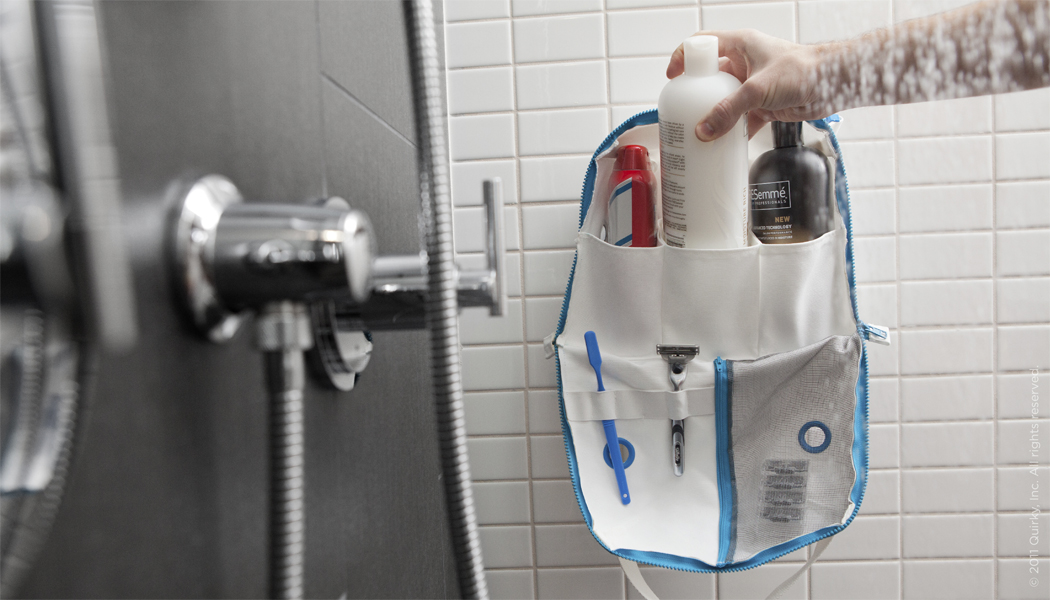
    Marc Rumaner from Chicago, Illinois submitted his idea for a shower hook that people could store everything from towels to loofas on when needed to Quirky. After making it to eval a first time but not coming out a winner, Marc used the feedback he received to address all of the issues the staff found and resubmitted his idea. After his idea was brought to eval a second time, he came out a winner (his 10th win here at Quirky). Marc was able to bring us a prototype of his idea when he visited Quirky headquarters, and Quirky will be looking into ways we can create a discreet and functional way to hold your towels where you need them.


    Catherine Matthias and Stewart Jones from Oregon came up with their idea for a  linking-style clasp has no moving parts to combat the issues people face with standard jewelry clasps. The clasp works like magician’s rings, opening and closing the jewelry connection when the small, tapered openings on each side are aligned at a 90 degree angle. These hooks could also be used in place of standard caribiners and other hooks without worrying about any moving parts breaking or failing. Quirky Looks forward to exploring the Jones’ idea and the potential behind their hook design.


    Jon Eisen from New York City, works in outside sales, but the beach bike has been a personal project of his for a long time. As someone who loves both spending time on the beach and riding his bike, he really wanted to combine the two by making a specialty bike made to move swiftly on sand.  Without the proper prototyping equipment he got stuck when trying to engineer the chain, but he had felt that there had to be some other option aside from using 4 wheeled vehicles to move around on the sand, so he began to explore the option of creating a scooter. Since scooters are much less complicated, he was successful in making his own sand scooter that his kids love.  Not knowing how to go forward with it, he brought it to Quirky to help him find a way to make this easier to store and to transport to the beach. Quirky saw the challenges that creating this scooter will bring, but we could not ignore its possibilities and its obvious lure as fun beach toy.


    Talia Wiener, a jewelry designer originally from Jerusalem, Israel, is finishing her last year of her masters degree in cultural studies. She strongly believes in breaking the patterns of thinking that we are accustomed to, and because of that, she has always loved the proverb “you can have your cake and eat it too” (which exists in Hebrew as well as many other languages). To encourage others with her beliefs, she decided that she should bring this proverb to life with her taste and serve cake idea.  Her idea stemmed from the thought:  why not be able to have a bit of the cake that you just baked without feeling the guilt of ruining its perfect shape? And so, she added a corner to an otherwise round cake pan, to allow for a piece specially made for the baker. The Quirky staff realized that there would have to be a way to make that extra piece easily separate from the rest of the cake, as to not ruin the overall look, but aside from that, the staff felt this was a simple enough idea that we should definitely work towards making into a product.


  • Mon, Jul 9 2012

    Props Sku Select

    By nathan at 11:02 am

    We will be sku selecting Props in the next few hours. Moving forward, we are going to give a breakdown of the influence for each sku select here on the blog before launching.

    Here are the details for Props:

    Props was not part of the old commitment system. In the new system, anyone who participated in the project will be eligible to buy in presale for influence.

    If you are eligible, you will receive an email with a link you can use to buy the product. If you do not receive the email by tomorrow morning, and you believe you are eligible, please contact customer service.

    The maximum number of units that can be bought by any person for influence is 25.

    There is 15% presale influence available.

    Please contact customer service if there are any questions.

Page 1 of 3123»