Archive for May, 2012

  • Thu, May 3 2012

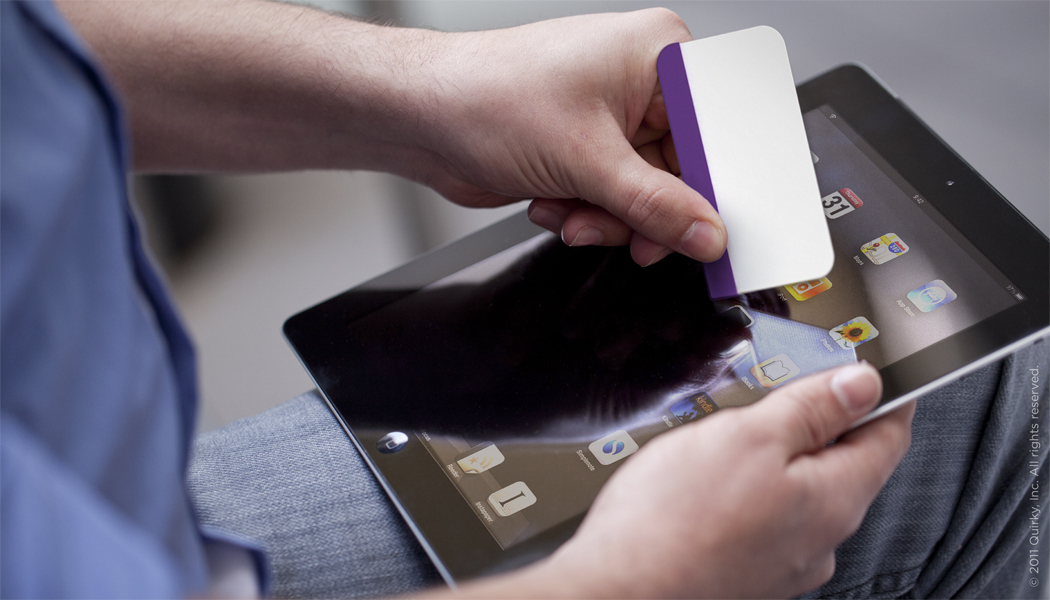
    Put some style in your stylus with Cipher. This wallet sized card is made of a capacitive material that will interact with any touch-screen device. The traditional stylus is hard to carry and easy to lose; Cipher lives in your pocket alongside your credit cards and driver’s license so it’s never out of reach. It’s the perfect solution for those text-happy moms or iPhone artistes.

    Neil MacAloney envisioned a stylus that was easy to carry around and always at the ready. He built a model, submitted his idea to Quirky, and over 1,075 influencers helped make his vision a reality. You can see the fruits of their labor in the Upcoming section now.

    Features:
    -Wallet sized
    -Conductive construction with writing tip; works with smartphones, tablets, public touch-screens
    -Easy-to-grip surface
    -Blank area for business/contact info
    -Retails with 2 cards per pack; bulk orders of branded cards also available

    Materials:
    -Conductive plastic

    Dimensions:
    -84mm W x 48mm H x 2.5mm D

    Price, qty and features subject to change during production process

    Branding information TBA


  • Wed, May 2 2012

    Pod Power is moving into production!  Our retailers are confident in the product.  Take a look at it in the Upcoming Section and help us determine the price, by playing the Pricing Game.

    Congratulations to Kate Vallon and all of the 2,498 community members that helped influence the product!

  • Wed, May 2 2012

    Yesterday marked the start of National Inventor’s Month, an exciting time of year for us at Quirky. Throughout the month of May, we’ll be honoring the contribution that American inventors have made to our world, and the incredible tools and products they brought to life. From lightening rods to mobile phones, American ingenuity has compiled an unprecedented catalogue of work.

    In fact, the list of inventors was so impressive that we had a hard time deciding who to feature: naturally, our solution was to feature all of them. As some of you may have noticed, we’ve extended the timeline on Quirky’s Facebook page back to 1641, and transformed it into a timeline of American invention. From the first North American patent all the way to the present, we’ve chronicled the Who’s Who and What’s What of innovative minds and products throughout our nations history. There are close to 200 entries posted already, and we’ll be continuously adding more, so be sure to pop in and check it out! The origins of some of your favorite products may surprise you.

  • Tue, May 1 2012

    Today marks the first day that the Empire State Building is surpassed by One World Trade Center as the tallest building in New York, a title it has held since the tragic events of September 11, 2001. Coincidentally, the date also marks the structure’s 81st birthday, and the juxtaposition serves as a stunning reminder of the skyscraper’s history, and the monumental achievement it represented when first constructed. The tallest building in the world at the time, it would maintain its title for 41 years, engraining itself as an essential part of both New York and American culture. However, as newer, taller structures have risen across the world, the architectural uniqueness of the Empire State Building has diminished, making it easy to forget what a man-made wonder the construct really is. What makes it so sensational? We’re glad you asked.


    The Speed of Construction

    The Empire State Building may be the first monumental building project to actually finish ahead of schedule. Architect William F. Lamb was able to complete the full blueprints in two weeks, hastily incorporating aspects of his prior work on the Reynolds Building in Winston-Salem, NC (Empire State Building staff still send a card to the Reynolds Building every Fathers Day, as a tribute to their predecessor). Construction began on January 22nd, 1930, and involved nearly 3,400 workers who would be responsible for assembling the building’s 2,768,591 square feet. Because 40 Wall Street and the Chrysler building were both under construction when the project began, competition had already spurred work to a fever pitch, but contractors found that the Great Depression’s effect on material and labor costs sped the process up even further. Originally projected to take 18 months, around-the-clock work saw the building completed after only 15. The financial savings were even more dramatic: though contemporary estimates placed the cost of construction at $43 million (close to $1 billion today), the final total barely reached $24.7 million. Heck, the difference could pay for a whole second building.


    The Airship Terminal

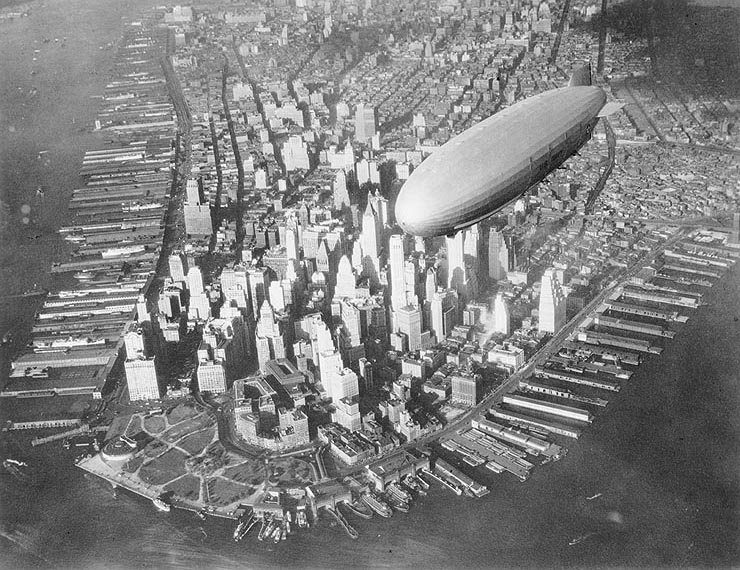
    Now a distinctive feature of the Manhattan skyline, the Empire State Building’s spire was originally built with a mooring platform for dirigibles, in anticipation of a boom in airship transportation. The 102nd floor was constructed as a landing platform, complete with gangplank, and dedicated elevators were built to accomodate the flow of passengers. However, to the disdain of steampunk enthusiasts everywhere, architects discovered that the building’s mass created violent updrafts, making docking a dangerous and unpredictable process. With no means of mooring dirigibles to the building, and with faster means of transport quickly taking precedence, the project was sadly scrapped, and the spire was repurposed as a radio tower in 1953.


    The Structure’s Size

    Though it has since been surpassed by larger, more modern skyscrapers, the Empire State Building is still a colossal construct by any standard. The structure consists of 102 floors, and reaches a height of 1,454 ft (spire included). Top to bottom, the building contains over 473 miles of electrical wire, and the cables for the building’s 73 elevators would stretch from New York to Baltimore if laid down end to end. The human capacity of the structure is equally impressive, as its 1,000 offices hold almost 21,000 employees, a population so large it merits its own zip code: 10118. In total, this adds up to 340,000 tons of American ingenuity, and tallest or not, we think that’s something worth celebrating.

    Sources:
    About.com
    OnBoard
    Wikipedia

  • Tue, May 1 2012

    Get out your umbrellas, folks. There’s a storm heading this way. That’s right –  we’re brainstorming two new products tomorrow (Wednesday @ 6pm EST):

    - Flour Dispensing Rolling Pin

    - Pill Purse

    If you’re new to brainstorms, allow us to explain. Every week, QDS blows a few product ideas wide open to kick off the design process. You can take part in that. Here’s how:

    1. Topics are posted above. In your wildest dreams, what would be the perfect way to make that product? What should it do, and what problems should it prevent? It’s a brainstorm, so anything goes.

    2. Visit the QuirkyLive Channel at 6pm ET on Wed. Log in on Ustream and throw ideas at us in the live chat.

    3. Can’t join the live brainstorm? Be sure to add your comments here before the start time, and we’ll have them in mind.

  • Tue, May 1 2012

    For some, the task of removing an electric cord from a wall socket can be a constant daily challenge. With Power Pull, we aim to make life a bit easier. Plugged in between the wall outlet and your device’s power cord, Power Pull allows you to simply push or pull its leveraged arms to easily remove it and your device from the wall. Disengage it with with virtually anything: your palm, fist, foot, elbow, or assistive devices such as a cane or crutch. Power Pull is even ideal for hard to reach outlets, where finding the right leverage to yank out a plug in the traditional way can be nearly impossible.

    After observing her friend struggle to remove a plug from an outlet due to complications from arthritis, Barbra Winston came up with an idea for a device that would allow someone to easily pull a plug out from a wall. With the help of QDS and 4,177 community members, we’re ready to pull back the curtains on Power Pull and launch it to the Upcoming page. Check it out for yourself today.  


    Features:
    –One three-pronged outlet with leverage arm
    –Rotating leverage arm that snaps into place at right angles
    –Works great on wall outlets or on power strips
    –Push or pull with a hand or a foot to release

    Materials:
    –Plastic

    Dimensions:
    –7.5 cm H/ 4.75 cm W/ 3.5 cm D

    Price, qty and features subject to change during production process