
Today marks the first day that the Empire State Building is surpassed by One World Trade Center as the tallest building in New York, a title it has held since the tragic events of September 11, 2001. Coincidentally, the date also marks the structure’s 81st birthday, and the juxtaposition serves as a stunning reminder of the skyscraper’s history, and the monumental achievement it represented when first constructed. The tallest building in the world at the time, it would maintain its title for 41 years, engraining itself as an essential part of both New York and American culture. However, as newer, taller structures have risen across the world, the architectural uniqueness of the Empire State Building has diminished, making it easy to forget what a man-made wonder the construct really is. What makes it so sensational? We’re glad you asked.
The Speed of Construction

The Empire State Building may be the first monumental building project to actually finish ahead of schedule. Architect William F. Lamb was able to complete the full blueprints in two weeks, hastily incorporating aspects of his prior work on the Reynolds Building in Winston-Salem, NC (Empire State Building staff still send a card to the Reynolds Building every Fathers Day, as a tribute to their predecessor). Construction began on January 22nd, 1930, and involved nearly 3,400 workers who would be responsible for assembling the building’s 2,768,591 square feet. Because 40 Wall Street and the Chrysler building were both under construction when the project began, competition had already spurred work to a fever pitch, but contractors found that the Great Depression’s effect on material and labor costs sped the process up even further. Originally projected to take 18 months, around-the-clock work saw the building completed after only 15. The financial savings were even more dramatic: though contemporary estimates placed the cost of construction at $43 million (close to $1 billion today), the final total barely reached $24.7 million. Heck, the difference could pay for a whole second building.
The Airship Terminal
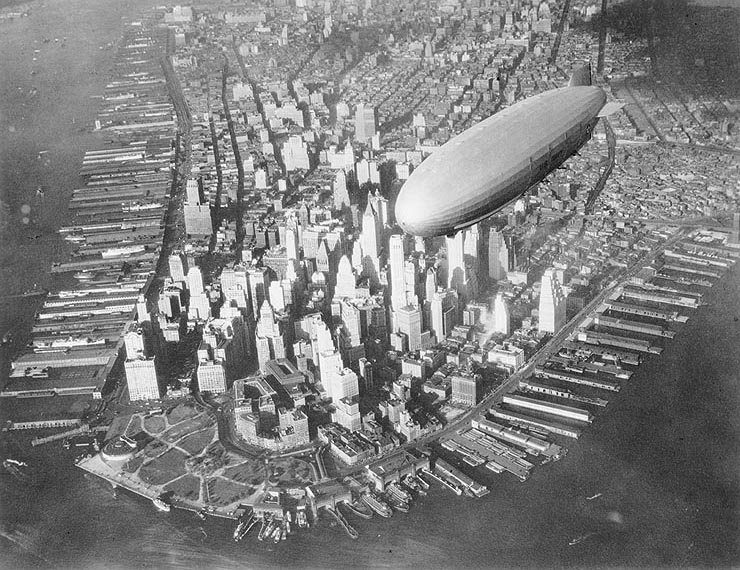
Now a distinctive feature of the Manhattan skyline, the Empire State Building’s spire was originally built with a mooring platform for dirigibles, in anticipation of a boom in airship transportation. The 102nd floor was constructed as a landing platform, complete with gangplank, and dedicated elevators were built to accomodate the flow of passengers. However, to the disdain of steampunk enthusiasts everywhere, architects discovered that the building’s mass created violent updrafts, making docking a dangerous and unpredictable process. With no means of mooring dirigibles to the building, and with faster means of transport quickly taking precedence, the project was sadly scrapped, and the spire was repurposed as a radio tower in 1953.
The Structure’s Size

Though it has since been surpassed by larger, more modern skyscrapers, the Empire State Building is still a colossal construct by any standard. The structure consists of 102 floors, and reaches a height of 1,454 ft (spire included). Top to bottom, the building contains over 473 miles of electrical wire, and the cables for the building’s 73 elevators would stretch from New York to Baltimore if laid down end to end. The human capacity of the structure is equally impressive, as its 1,000 offices hold almost 21,000 employees, a population so large it merits its own zip code: 10118. In total, this adds up to 340,000 tons of American ingenuity, and tallest or not, we think that’s something worth celebrating.

