

For the everday enthusiast, the flying machine was born on December 17th, 1903, as the Wright brothers took to the skies in the famous Wright Flyer. However, many of history’s greatest achievements were built on the shoulders of giants, and for Wilbur and Orville Wright, that giant was Sir George Cayley.
Cayley was born in Yorkshire, England in 1772, son of the wealthy Thomas Cayley, 5th Baronet of Bromley. He took an early interest in mathematics and engineering, and he continued to work in these fields throughout his life, designing everything from tension spoke wheels and seatbelts to artillery shells. However, his true passion was the pursuit of flight, and sketches in Cayley’s schoolbooks suggest that he was toying with ideas for generating lift as early as 1793. His father’s wealth allowed him to conduct numerous experiments and research projects, and he made a point of sharing the results of all his research, in the belief that they should be readily available to the public (if only every inventor shared the same sentiment).
Most of Cayley’s research focused on exploring the principles of aerodynamics, and the design features that would be necessary for an aircraft to take flight. Many of his discoveries were so rudimentary that they might qualify as common sense today, but it’s easy to forget that, at the time, a scientific understanding of flight was nearly non-existant. While basic components such as Bernoulli’s Principle had been discovered, most had never before been applied to the concept of aerial flight, and Cayley’s work represented the crucial first foundation for all aeronautical research to come. While listing all of Cayley’s discoveries would require volumes, here are a few of his most important contributions:
- The invention of the cambered airfoil, an asymmetrical wing shape capable of generating lift, and the core component of human-powered flight.
- The identification of the four vector forces that influence an aircraft: thrust, lift, drag, and gravity.
- The discovery that a dihedral angle contributes to lateral stability in flight. In short, he found that positioning wings at an upward angle vastly improved an aircraft’s horizontal stability.
- The use of rudders and elevators for in-flight control. Yeah, this one blew our minds too.
- The exploration of biplane and multiplane wing designs.
The collective results of this work were shared in a revolutionary three-part treatise titled On Aerial Navigation, which was first published in 1809, and represents the first dedicated volume on the study of flight. If you don’t want to take our word for it, you can go directly to the source; NASA has kindly published all three parts online: Part 1 – Part 2 – Part 3.
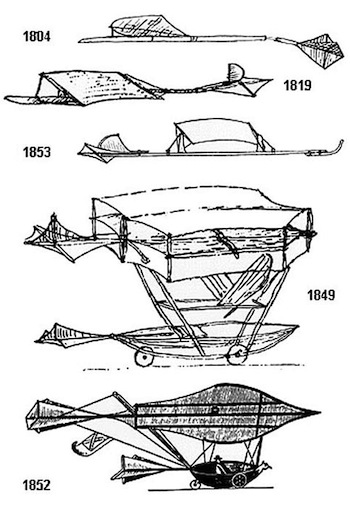
Much of Cayley’s research would later take physical shape in the form of models, which he began flying as early as 1804. These gliders, though rudimentary, defined the format for all aircraft to come, featurigng large, lift-generating wings towards the front, and an adjustable tail plane in the back with both horizontal and vertical stabilizers. While he built several models over the course of his life, the most famous was a manned version complete with cockpit and landing gear, which successfully flew in 1853, pulled by farmers and ropes. While technological limitations would render self-powered flight impossible for decades to come, this man-powered liftoff is recognized as the first manned glider flight, at least the first to meet with any success.
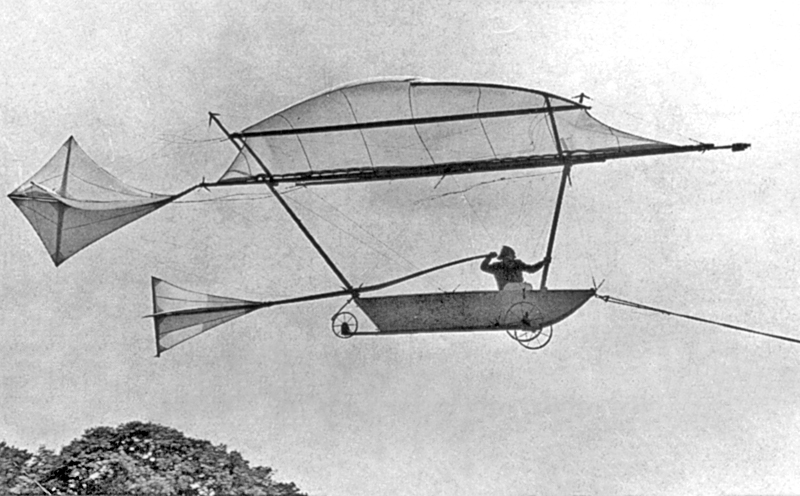
George Cayley died on December 15th, 1857, more than a decade before the birth of Wilbur Wright. However, while Cayley never took to the skies himself, his legacy lives on: he helped found the first Royal Polytechnic Institution (Now the University of Westminster), and is widely considered to be the father of aerodynamics. He described the air as “an uninterrupted, navigable ocean that comes to the threshold of every man’s door”, and his theories and philosophies served as inspiration for some of histories greatest aviators, including the Wrights themselves. Several scale models of his glider have also been constructed in modern times, including the replica below, flown by Derek Piggott in 1973. If you decide to construct a replica of your own, let us know! We’d be happy to help pull the ropes.
Sources:
Wikipedia
Britannica
NNDB

