• Wed, Apr 11 2012

    Tap is moving into production!  Our retailers are confident in the product.  Take a look at it in the Upcoming Section and help us determine the price, by playing the Pricing Game.

    Congratulations to Anat Steiner and all of the 2,162 community members that helped influence the product!

  • Tue, Apr 10 2012

    Forty-two years ago today, The Beatles ended their musical partnership and simultaneously cemented their place in the lexicon of popular music forever. While their songs are still very much a part of Western culture, their innovation didn’t stop there. Inside famed Abbey Road Studios, the Beatles and their team of engineers and producers invented new ways of recording music and subsequently paved the way for studio techniques that are still used to this day. Here we’ll take a look at just a few of their fab achievements.

    Artificial Double Tracking (ADT)

    It was (and still is) common practice to record certain vocal parts twice. This technique increases the overall loudness and strength of a vocal, and is used to add some extra punch to a chorus or emphasis to a verse. But the process was painstaking; the performer had to recreate every nuance of the original vocal line until the two were identical. John Lennon hated double tracking his vocals. Ever the arbiter, Beatles producer George Martin reassured Lennon that even his idol Elvis Presley double tracked his vocals. But Lennon still struggled and became frustrated with this daunting task. Abbey Road Engineer Ken Townsend reached a solution to the problem while on a drive home from a particularly difficult night during the Revolver sessions. He posited that if an audio signal could be split into two, and one of those identical signals was slightly slowed down, the effect would be similar to a double-tracked vocal. When he returned to the studio, he successfully applied his idea by duplicating the original recording onto another tape machine with variable speed control. The Beatles continued to use this trick on their subsequent albums for the remainder of their career. Today, it is popularly known as automatic double tracking and is still used on modern recordings.

    Sampling


    Using previously recorded pieces of sound in a new context, or sampling, is commonplace in contemporary music. But the Beatles were one of the first adopters of this tactic. In “Yellow Submarine”, George Martin and his colleague Geoff Emerick sampled a brass solo from an old John Phillip Souza recording in the same key. They spliced the solo into parts and rearranged it to fit the musical break in the song. They tried this again in “Being for the Benefit of Mr. Kite”, using samples of steam circus organs called calliopes. This time the duo mixed a number different samples into random order, and recorded the result. This, along with Lennon’s lyrics plucked right from an antique circus ad, created the surreal collaged carnival effect that drives this memorable tune.

    Pitch/Time Manipulation

    When listening to Sgt. Pepper’s Lonely Hearts Club Band, you’ll notice the dreamy, whimsical, almost psychedelic quality of the of album. This recording marked a turning point for the Beatles; it was the first time they were free of time constraints and able to fully focus on studio experimentation. Part of this was the exploration of pitch and time manipulation achieved by speeding up or slowing down tape machines. In “When I’m Sixty-Four”, Paul McCartney performed the song at a slower speed so that the normally timed vocals would be higher in pitch; closer to the childlike tone of the song. Sometimes pitch shifting was used to pull off seemingly impossible musical feats; during a particularly difficult piano pass, producer George Martin decided to play the part in half time and later return it to normal speed for the final mix. Perhaps most miraculously, pitch shifting made it possible to combine two seemingly disparate tracks into one. The classic track Strawberry Fields Forever was created by pitch shifting two takes, each in different keys and tempos, until they flowed together seamlessly.

    Multitrack Recording

    Up until the early 60s, most studio recordings were achieved by recreating a live setting and generally mic’ing each performer while they played together, all feeding into one or two tape tracks. While they weren’t the first to utilize multi-track recording methods, the Beatles took advantage of these innovations in ways that were yet unseen. Instead of recording altogether, they used advanced tape machines that could record one performance, rewind to the beginning, and record the next performance layered on top. This non-linear method arguably changed record making from a science into an artform. It was now possible to build upon each song like a house of cards. They recorded almost everything that occurred in a session, refusing to throw away anything that could prove to be important. They devoted countless hours to perfecting their recordings,eventually retiring from live concert performance entirely. The Beatles became the world’s first pop studio band; every new album set the bar higher for audio technology and innovation.


    Sources:

    eHow: Beatles Recording Techniques

    The Evolution of Beatles Recording Technology


  • Tue, Apr 10 2012

    Customize how you listen…with Siphon!  Designed to easily allow you to switch between different outputs, Siphon is an audio splitting device that improves quality and amplification.  Simply plug the splitter into one of your computer’s USB ports and attach your headphones, earbuds, or speakers to one of the three audio jacks. Toggle between the three jacks using the integrated jog dial, ensuring that you can jam out to whatever you want from the right device for the occasion. Use the included adhesive backing or permanent mounting plate to place the Siphon in the best location, and perch your headphones on the angled plate on top when you are done.

    As an audio enthusiast with multiple pairs of headphones, inventor Shawn Lee became frustrated with the lack of flexibility his single headphone jack provided. Seeking to eliminate the need to continually plug/unplug and search for the correct cord, Shawn thought of a splitter to transform his audio set-up.  Now, with the help of 9,483 influencers, Siphon is debuting in the Upcoming section today!


    Features:
    - Three audio jacks and jog dial
    - Angled fascia plate for holding headphones
    - Adhesive backing or permanent mounting plate for perfect positioning

    Materials:
    - Plastic and aluminium

    Dimensions:
    - 25mm W x 21mm D x 124mm H


    Price, qty and features subject to change during production process

  • Mon, Apr 9 2012

    Today marks what would be the 182nd birthday of Eadweard Muybridge, a pioneer in photographic studies of motion and motion picture projection.

    Born Edward James Muggeridge in Kingston upon Thames, England, Muybridge immigrated to San Francisco in 1866 to start a career as a photographer. Despite his decision to adopt an unconventional spelling of Edward in the US, Muybridge remained an obscure figure until 1868, when his large photographs of the Yosemite Valley in California earned him worldwide notoriety as a landscape photographer.

    Muybridge’s real breakthrough came in 1877 while helping former California Governor and railroad magnate Leland Stanford win a bet on a prominent topic of debate in horse racing circles: Do all four legs of a galloping horse leave the ground at once? To answer this esoteric question, Muybridge had to improve upon the glacial shutter speeds of cameras at the time. He developed a system of multiple cameras with shutters connected to wires. When the wires were tripped the shutter would close, causing each camera to take it’s own picture as the horse ran by. But he wouldn’t settle with static images; he also wanted to show his subjects in motion.

    In 1879 Muybridge developed the Zoopraxiscope – a machine that projected images in quick succession from photographs printed on a glass disc. The demonstration of this innovative new device in 1882 not only helped Stanford win his bet, but is often quoted as the first ever showing of a moving picture. His pioneering work has even been cited as a major inspiration in the invention of the modern motion picture camera by Thomas Edison.

    Muybridge went on to conduct many more studies of motion through film, including a series of pieces on human movement funded by the University of Pennsylvania. His later work was notorious for depicting nude models (male, female, young and old), but was ground breaking in it’s analysis of human form and motion.

    With his new photographing and display inventions, Muybridge furthered the physical study of motion and became the forefather of motion pictures. Though we have come a long way since using glass disks and lanterns, Muybridge’s original design literally set the stage for modern film. Check out some of his work and other pieces inspired by it on Vimeo, YouTube, and at the New York MoMa.

    Sources:

    MoMA

    Britannica.com

    About.com Inventors

    Wild Film History

  • Mon, Apr 9 2012

    Bridgette Bennett, a Food Scientist from Genevieve, MO, woke up one night and realized the light she saw in her living room was from a candle she forgot to blow out before bed. She knew this was unsafe and began thinking of ways she could ensure it wouldn’t happen again. Bridgette’s idea is to create a candle wick that would only stay lit for a specific amount of time before it burns out so candles are not accidentally left burning. Quirky is excited to look further into Bridgette’s timed candle wick idea that would provide users with more connivence and piece of mind than standard candle wicks and possibly reduce the number of house fires each year caused by unattended candles.

    When Maria Morrill from Bayamon, PR was working as a receptionist, she realized her fingers were often quite cold at her desk and while typing. She tried to find a USB powered hand warmer she could use to keep her fingers warm but found that it didn’t exist. She found she wasn’t the only one with cold fingers at work and decided to submit her idea to Quirky. Quirky will be looking into ways that we can create a device that will keep people’s hands warm when they are at their computers.

    Kirk Spiegel is currently involved in medical product design and prototype development, based out of San Luis Obispo, CA.  Before working there, Kirk was in the aerospace industry doing rocket engine design on the Space Shuttle Main Engines for 32 years! His Electronic Steering Damper idea began when his twin sons bought sport motorcycles and looked into equipping them with after-market steering dampers.  After Kirk looked into what was available on the market he thought that he could do it better and faster with new technology.  His product is not only a safety enhancing product but a performance enhancing product as well. Between the large number of new motorcycles sold in the US every year and the millions of potential sales for after-market retrofit applications, Kirk and Quirky both agree that it is a good idea to explore this invention’s potential.


    Carla Holt now works part-time in the retail industry after working in the legal system for many years.  She came up with this idea after waking up one night thinking about her father; he was a mechanic by trade. The next day, she was coming home from work during a rain storm and she noticed a person on the side of the road struggling with jumper cables trying to jump start another person’s car. Carla believes this idea can be the next big idea because millions of people use Booster Jumper Cables to jump start vehicles worldwide. The cables need to be managed a lot better for usage. They are a hassle to untangle and store. She also believes that this product would impact consumers in a very big way by allowing a faster and less cumbersome way to use and store the cables. Quirky is willing to explore this idea in order to understand its full potential.

    Team Jenson, made up of Sonia Covarrubias-Garcia and Jennifer Jedlicka, has come up with yet another idea that Quirky has decided to explore.  Sonia, an entrepreneur and stay at home mom from California, and Jennifer, a program manager at an engineering firm from Maryland, have been trying to find a way to create something that can easily grab pasta to taste test while they are cooking.  They did not like that it is so difficult to pick up pasta because it tends to slip out of grasp and splash back into the hot water.Jen really loved the idea of creating cooking tweezers, especially since there are so many applications besides picking up pasta (picking up a piece of eggshell, making wonton noodles, etc.), but they wanted to incorporate something else to aid in the pasta-cooking process.  Then they thought  of how measuring pasta can be a pain, and brainstormed ways they two ideas could be incorporated together.  Their final result is a pair of measuring pasta tweezers which they feel would be a great tool for new cooks and college students, and would fit in Quirky’s kitchen line.  Quirky decided that this idea is worth exploring and will look into its potential over the next few weeks.

  • Fri, Apr 6 2012

    Though baseball is one of America’s oldest sports, with a tradition dating back to 1845, the technology surrounding the sport has seen surprisingly little change. Though the stadiums and fanbase have grown, along with player salaries, the game is still played with the same wooden bats, stitched leather gloves, and chalk lines that were used by the Great Bambino. However, while the fundamentals have stayed true to tradition, inventors have nevertheless tried to improve the sport with a variety of devices, and we’ve collected four of our favorites below in tribute. Some of them are clever. Some of them are weird. All of them, however, are a part of the American pastime, and we raise our glasses in their honor regardless.
    Audible Signal Base

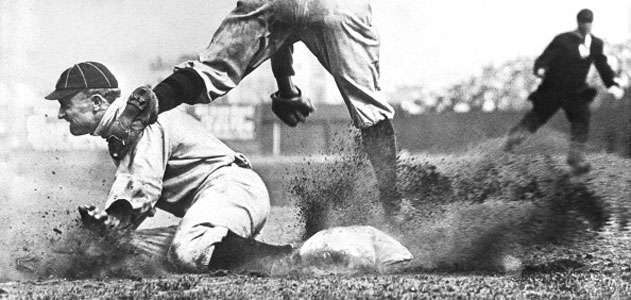
    When a runner slides into first base, the difference between being “SAFE!” or “OUT!” can come down to a miniscule margin of error, and disputes over an umpire’s decision have caused yelling matches and burst veins beyond counting. Indeed, the problem was identified early on, because in 1914, an inventor named Stephen H. Wells patented the first audible signal base, which was intended to improve the accuracy of an umpire’s call. The device used a pressure-sensitive plate to detect the impact of a baserunner’s foot, which would set off an electronic bell to alert the umpire at the moment of contact. This would allow the umpire to focus his visual attention on the moving ball. The technology, though well received, was never introduced on a wide scale, but we still applaud Mr. Wells for his dedication to peace and good will towards men on the baseball pitch.

    The Quest for the Unbreakable Bat

    Ever since man began striking flying objects with wooden sticks (we’re guessing it started early), he has had to deal with the problem of those sticks breaking. Even today, it isn’t rare to see a bat shatter under the force of a speeding fastball, as restrictions on the size and material of bats mean that very little of the actual structure can be changed. One creative solution was dreamed up in the early 1900′s by two gentlemen from Connecticut: Arthur A. Hadden and Lincoln S. May. This inventive duo developed a bat with an axial bore in the middle, that was filled by a wooden core with the grain at a right angle to the grain of the outer wood. This would allow the bat’s overall structure to better withstand impact, without the use of metal or polymer. Like Stephen Well’s audible signal base, the bat did not see widespread use, but we’ll leave you with a contemporary review from “The Baseball Magazine” as a judgment of its worth:

    “With this new war club the ambitious batter may confidently plan to send the ball whimsically whistling its way to the Durham sign-board. He need not fear that the bat will break.”

    Harvey the Rabbit

    Charlie Finley achieved a great many things in his lifetime. As owner of the Oakland Athletics, he was responsible for moving the team to California, for selecting the franchise’s iconic green and gold coloring, and for building a World Series dynasty that included the likes of Reggie Jackson and Joe Rudi. However, we at Quirky like to remember him as the man who invented “Harvey”.
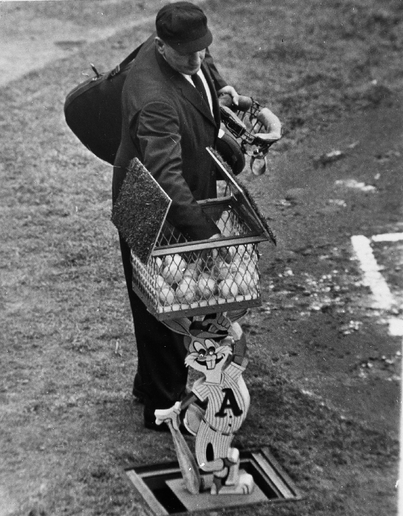
    Harvey lends an umpire a helping hand.

    Finley’s organization was famed for their marketing skill, and one of the entrepreneur’s most delightful innovations was a mechanical rabbit that delivered balls to the umpire behind home plate, affectionately named Harvey. Dressed as an Athletic’s player, Harvey would rise out of the earth like a mystical messenger, complete with glowing eyes and a rotating mechanism that spun him about as he ascended. Though Harvey’s career came to a close in the 80′s after a change in team management, he will forever live on as baseball’s most dedicated ball-boy.

    Pitcher’s Mirror

    Though you may not have heard his name, Danny Litwhiler is remembered by many as baseball’s most prolific inventor. On top of his careers as a Phillies outfielder and long-time coach of college baseball, Litwhiler developed over 100 inventions to benefit his favorite pastime, ranging from a special clay for keeping infields dry to the first radar gun used to measure pitch speed. The inspiration for his most creative invention came when he was watching TV, and saw a commercial depicting bullets bouncing off the front of an airplane: if glass could be made to withstand the impact of a bullet, surely it could stop a fastball as well! Litwhiler set to work designing an unbreakable mirror, that would allow pitchers to watch their form from a batter’s perspective, helping them to detect flaws and tells in their form.

    With the help of Pittsburg Plate Glass, he came up with a 5 x 3 foot mirror that weighed 150 pounds, and could withstand the impact of a 100mph fastball without cracking (the glass alone was almost an inch thick, and was framed in steel). The device was used by Litwhiler for decades during his college coaching career, and his mighty piece of glassware is still being used by the Cincinnati Reds and their pitching staff. That, Quirks, is dedication if we’ve ever seen it.

    Sources:
    The Baseball Magazine
    Baseball News
    Sports Illustrated
    Wikipedia

  • Fri, Apr 6 2012

    There’s a Brainstorm coming into town next week, but it’s touching down at a different time!  Next week’s Brainstorm will be held on Wednesday at 4pm EST. Please board up your windows, stay indoors, and participate with us!

    Start Brainstorming with us on these ideas:

    -Work Boots (paint stilts)

    -Key Hider

    Below are the results from last week’s session, featuring the discussion with our designers, invention ambassadors, and community members (click either image for a larger version):

    Product 289 – Short Term Breathing Apparatus

    Product 297 – The Water Vest

    You can view the entire Brainstorm in all its glory here, barring the first couple minutes without audio–it comes in at ~2:27):

    If you’re new to brainstorms, allow us to explain. Every week, QDS blows a few product ideas wide open to kick off the design process. You can take part in that. Here’s how:

    1. Topics are posted above. In your wildest dreams, what would be the perfect way to make that product? What should it do, and what problems should it prevent? It’s a brainstorm, so anything goes.

    2. Visit the QuirkyLive Channel next Wednesday at 4pm EST. Log in on Ustream and throw ideas at us in the live chat.

    3. Can’t join the live brainstorm? Be sure to add your comments here before the start time, and we’ll have them in mind.

  • Thu, Apr 5 2012

    Today marks the 61st birthday of entrepreneur and inventor Dean Kamen. Although he has created many things, he is best known for bringing us the Segway: the two-wheeled electric vehicle of the future! Exactly when that future will arrive has yet to be determined, but we nevertheless salute his achievement with a list of our favorite Segwayists.

    6) Segway Tourists

    Walking tours are so last century. The only true way to experience ancient ruins, sacred relics, and famous monoliths is aboard your Segway. Helmets are (for some reason) required.

    5) Segway Cops

    While not exactly the most intimidating of law enforcement vehicles, Segways offer a great way for the boys in blue to cover more ground than they could on foot. We’ve yet to see our first high-speed Segway pursuit, but then again these babies top out at 25 mph.

    4) Segway Polo Players

    Didn’t make the cut at this year’s Quidditch tryouts? Grab a mallet and play a few chukkers of Segway Polo. The Sport of Kings just got a lot more kingly.

    3) Justin Bieber

    We’ve all been there. There’s a hoard of screaming tweens on your heels, you won’t have a driver’s license for four more years, and you’re way too rich to own a bike. The only way to make your escape is via your trusty Personal Transport. Go Biebs, go!

    2) Paul Blart: Mall Cop

    Batman had the Batmobile. Mr. Incredible had the Incredi-Mobile. Paul Blart fights mall crime aboard the Blart-Mobile. Shoplifters beware!

    1) Gob Bluth

    Arrested Development’s Gob Bluth was rarely seen without his Segway. For any aspiring magician illusionist, it’s a prerequisite. Sure, a new Segway PT will set you back about five grand, but there’s always money in the Banana Stand.


  • Thu, Apr 5 2012

    Assembling a stellar castle or man-sized Star Destroyer gives any kid, young or old, an unparalleled sense of accomplishment. But why be restricted to right angles and rectangular shapes? With Curvables anyone can build curving and organic forms. This 60 piece kit consists of four types of flexible “knuckles” with two, three, four, and five connections respectively, as well as four types of adjoining rods. Mix and match these for whatever you and your child can dream up.

    Inspired by curved forms that have revolutionized architecture, Fred Bartels wanted to bring the same modern design aesthetic to children’s building toys. Being design junkies ourselves, we couldn’t help but fall in love with his idea. 1329 influencers answered QDS’s call to help develop the next generation of creative playthings, which you can see for yourself in the Upcoming section today.

    Features:
    -60 piece kit
    -4 types of flexible ended knuckle pieces
    -4 different length adjoining rods

    Materials:
    -Plastic adjoining rods
    -Hard plastic and metal centered knuckle pieces with flexible plastic ends

    Dimensions:
    -Knuckle pieces: 70mm long flexible ends
    -Adjoining rods: 5cm, 10cm, 15cm, and 20cm long

    Price, qty and features subject to change during production process

  • Wed, Apr 4 2012

    We’re sure many of you have noticed that the forums recently received a face lift. After listening to your feedback, we determined that a few things needed to be clarified. We now include descriptions below each forum type, just to make sure there isn’t any confusion:

    Also new to the forums is Q-News: your one-stop-shop (other than this blog) for company updates, announcements, policy guidelines, and clever missives from Quirky staff. We’ve kicked off the launch of Q-News with our first post Conduct By Users, a frequently requested and happily provided code of conduct for old and new users alike.

    We hope this will be a helpful reference if you are ever confused about what is and is not becoming of a Quirky community member.

    As always, feel free to shoot us an email at [email protected] if you have any questions or feedback about the new forum layout or the code of conduct.

Page 4 of 129« First...«23456»102030...Last »