• Wed, Apr 18 2012

    Vine is moving into production!  Our retailers are confident in the product.  Take a look at it in the Upcoming Section and help us determine the price, by playing the Pricing Game.

    Congratulations to Marc Rumaner and all of the 1,373 community members that helped influence the product!

  • Tue, Apr 17 2012

    This week’s brainstorm is shaping up to be a fun one, so sprinkle a little glitter on your thinking caps! The two new topics that will be discussed this Wednesday (6pm EST) are:

    - Glowing Friendship Bracelet

    - Folding Chair 2.0

    If you’re new to brainstorms, allow us to explain. Every week, QDS blows a few product ideas wide open to kick off the design process. You can take part in that. Here’s how:

    1. Topics are posted above. In your wildest dreams, what would be the perfect way to make that product? What should it do, and what problems should it prevent? It’s a brainstorm, so anything goes.

    2. Visit the QuirkyLive Channel at 6pm ET on Wed. Log in on Ustream and throw ideas at us in the live chat.

    3. Can’t join the live brainstorm? Be sure to add your comments here before the start time, and we’ll have them in mind.

  • Tue, Apr 17 2012

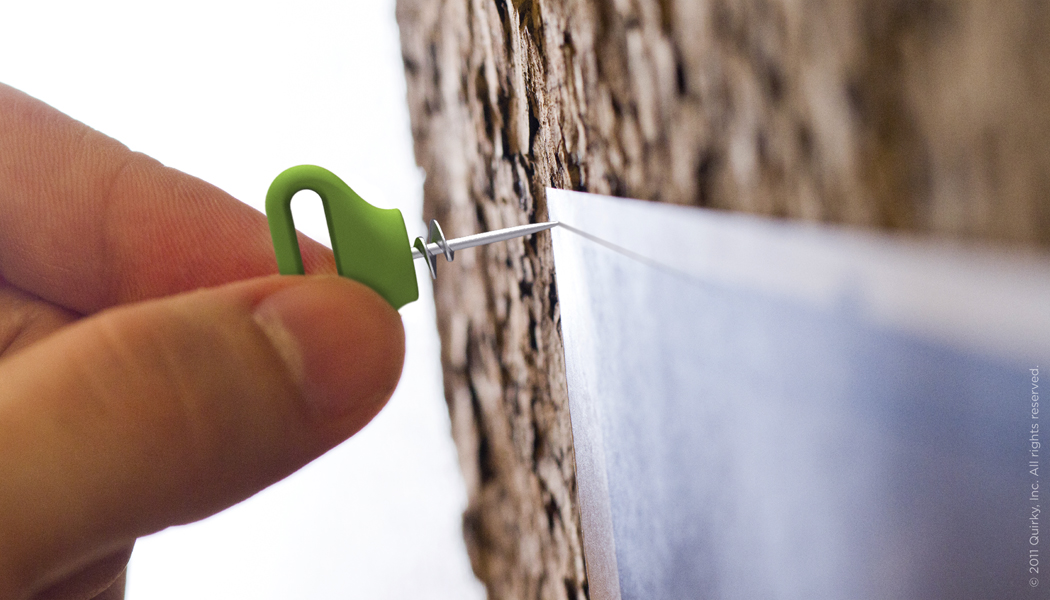
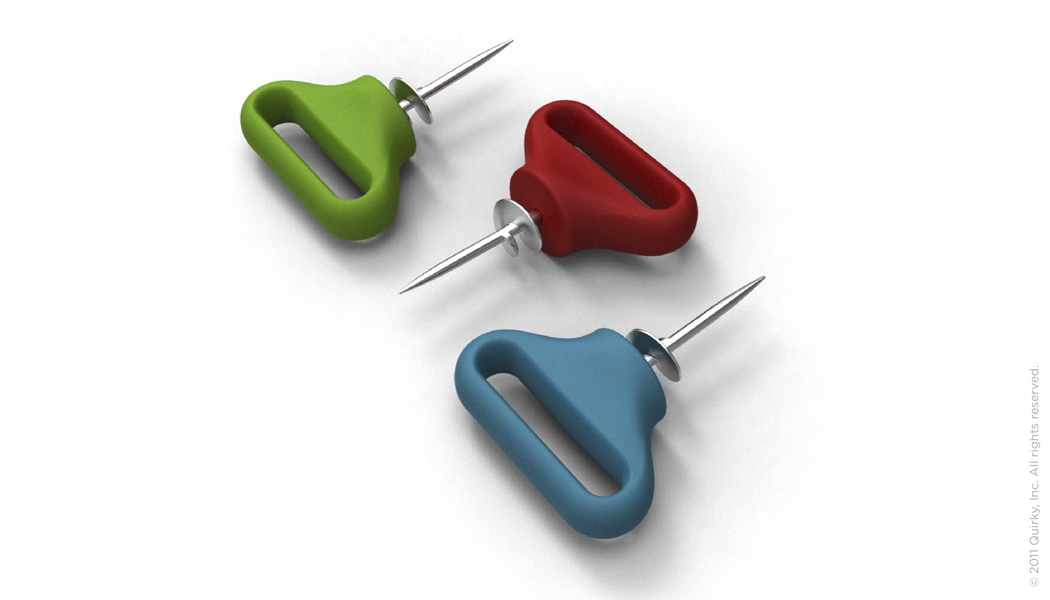
    Plain old pushpins? Screw ‘em! Introducing Tackits – the tack with a twist. The impetus behind this innovation is simple; regular tacks fall easily out of the wall or bulletin boards. Tackits’ corkscrew design twists into most any surface and provides a secure mount for the heaviest of Hallmark cards and monthly calendars. And with another flick of the wrist, you can cleanly remove Tackits and reuse as needed.

    Brian Erickson had what he called a “head-slapping simple” idea: mate a pushpin with a corkscrew and you’ll have a much stabler method of mounting to a bulletin board. We wholeheartedly agreed and put his plan into action. All 1,173 of you helped us shape it into Tackits and now you can see the result in the Upcoming Section.

    Features:
    -Corkscrew-style pin twists into place for a more sturdy hold
    -Easy to remove with a counter-clockwise twist
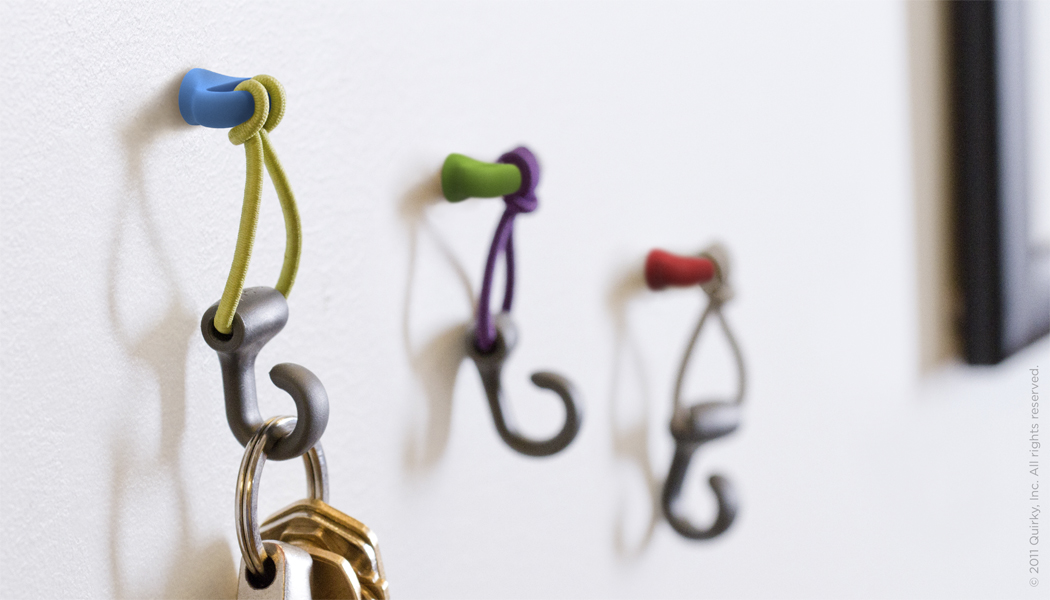
    -Unique head shape allows easy turning, hanging frames, and threading for crafty possibilities
    -Perfect for cork, drywall, and soft wood
    -One pack contains 50 Tackits

    Materials:
    -Polypropylene plastic head
    -Steel pin

    Dimensions:
    -21mm w x 9.5mm d x 29mm h

    Price, qty and features subject to change during production process

  • Mon, Apr 16 2012

    Mike Pearson a former technician for a semiconductor manufacturer from Idaho, came up with his 3-in-1 balance board idea accidentally. He was using a standard balance board that he had made, when the back of the board slipped off the roller, but not the front of the board.  With the back of the board stationary and the front of the board on the roller, Mike found that he could turn the board by adding pressure to either side, which is the same technique used for all board sports.  Other balance boards just move in one direction (either front to back or side to side).  Mike realized that his idea has a lot of potential since because it is funny and easy to learn, yet challenging enough to that users will want to keep using it.  Quirky recognized that potential and agreed that this could be a really fun


    As a student with 2 children who are also students, Kenneth Rubi from Miami, has found the need to use a stapler on many occasions. The problem with the way the stapler is designed is it is limited to stapling along an edge, when there are a lot of scenarios that something needs to be stapled in an unreachable spot. From making books with his kids all of the way to designing sets for one of his classes, Kenneth has had to crease or wrinkle the material in order to staple it properly, so in order to avoid that, he came up with his detachable stapler.  The people who do a lot of paperwork here at Quirky really thought that this could be useful and so we decided to explore this idea.


    Jeff Gulis, a Mechanical designer from Ontario decided to surprise his wife, Lori, for her birthday by submitting an idea that she has had for some time. Lori is a daycare provider and she and Jeff have two kids so it was only natural that she would come up with a product idea that appeals to kids.  It all started when she spotted fiber optic rings and she thought about applying it to the charms that young girls give their best friends.  After she discussed it with her husband, it formed into a light-up friendship bracelet that lights up when someone’s friends are near.  The Quirky staff discussed this for some time before they decided this might be a great product for kids and because of the response it received, it was definitely worth trying out.


    Kerry Collins an Environmental Health & Safety Manager from Eugene, Oregon has a daughter who was diagnosed with type-1 diabetes a few years ago. There have been times where her blood sugar has dropped to very low levels almost causing her to slip into a diabetic coma. The emergency treatment for extremely low blood sugar is a glucagon pen that is housed in an inconvenient and somewhat bulky kit. Sometimes Kerry’s daughter does not bring along her kit because of how inconvenient it is to pack when she is on the go. Kerry wants to create a discreet, convenient, and wearable medicine storage pouch for glucagon pens and EPI pens. Quirky looks forward to exploring Kerry’s idea and finding new ways to approach glucagon pen storage.


    Danon Seletkovic works for a construction company in Zagreb, Croatia and decided the addition of a carabiner hook to Bandits would make for a great addition to the Quirky line and the versatile functionality of Bandits. These carabiner bandits would allow people to Bandit in even more ways with it’s additional security. Quirky looks forward to checking out how we could develop Danon’s idea.


    Norbert Schnöde, a freelance communication consultant and comedy radio producer from Berlin, Germany,  was working as a software consultant and would use a whiteboard to scribble down his ideas. After hours with the marker in one hand and the cap in the other he decided there needed to be an easier way to quickly brainstorm ideas without having to fumble with caps and trays.  We will be looking into Norbert’s whiteboard suction cap idea that has the potential to finally make switching between talking and writing on whiteboards fast and easy.


    Anthony Williams is a Marine Electrician from Fincastle, Virginia. This idea originally came to Anthony when he was in the toy making business. He was trying to figure out a way to fly a helicopter using sensors, so that the helicopter knew when a wall or impediment was coming so that it could avoid the obstruction automatically. He started looking at robots for inspiration and noticed that they used sensors that stop the robots from hitting into the wall. He thought that he could integrate similar technology to his flying helicopter.  Anthony has built a working prototype of his optically actuated scrolling mouse and he says he uses it everyday.  Quirky is willing to take a look at Anthony’s prototype and explore the possibilites of integration for this product.


    Bobby Bravo is a dietitian from San Juan, Texas.  This idea came to Bobby when he was talking sports with his wife.  They both love the game of baseball and they know that athletes are always looking for a competitive edge.  His invention idea is a baseball that has the ability to track information that is valuable to the baseball player using it.  For a pitcher he wants it to be able to track the rotation of the ball and the speed, so the pitcher has a more thorough understanding of how well they are throwing each type of pitch.  For a batter, Bobby believes that this ball will be able to collect data on how fast the batter’s bat speed is.  All of the information will then be downloaded to a computer for analysis.  Quirky wants to pursue this idea and do a lot of research on what kind of technology would be needed in order to make this product a reality.


  • Sun, Apr 15 2012

    Today the world commemorates the 100th anniversary of the sinking of the Titanic. An enormous nautical achievement when it first set sail, the Titanic has become synonymous with disaster since its last day on April 15, 1912. The recent re-release of James Cameron’s 1997 film about it and the significance of its centennial, have inspired realizations and acts of remembrance for the tragedy, but few reflect on what advancements came from it.

    Rather than focus on the bad of this anniversary, let’s instead remember the progress through invention that came out of the Titanic’s voyage. First, take a look at this excerpt from a 1913 The Times of London article we recently found:

    That’s a lot of inventions! The shock of the Titanic’s sinking inspired inventors around the world to develop new devices that could prevent a similar tragedy from occurring. We dug a little deeper to learn about these innovations:

    The Internal Combustion Engine

    Mead Rotary Valve Engine, 1912

    While engine research wasn’t catalyzed by the Titanic’s sinking, the ships creation unquestionably played a role in its advancement. The luxury liner was the largest moving man-made object on earth when it launched, and it required powerful machinery to move it along. It’s enormous twin steam engines were technical feats in and of themselves, as well as stunning examples of the ongoing commercial research into engine technology at the time. As mentioned in The Times piece, the internal combustion engine in particular was of interest to inventors in 1912, inspiring a whole host of new innovations ranging from dubious implementations of a new rotary valve system for car engines, to internal combustion turbines.

    Life Rafts

    Detroit Ship Building Co., Department of Life Rafts: 1912

    The Titanic carried only 20 lifeboats with enough space for 40-65 people each, despite 2,200 passengers and crew members. After its sinking, inventors threw themselves at the problem of creating more compact and easier to deploy life rafts. Patents from around the world were filed to introduce new, more resilient boats, while shipbuilding companies opened entire departments dedicated to the research and implementation of these advancements.


    Steward Releasing Gear

    Disengaging gear was an important element of this as well. The Titanic and its sister ship Olympic featured a device known simply as Murry’s, which consisted of a network of pulleys, hooks, and rope feeds that allowed the life raft to be lowered into the ocean. The subsequent boom in development of similar systems focused on improving how evenly  the ends of a vessel are lowered, and on equipment placement changes that could accommodate boats with a greater deck sizes and volume of passengers.

    Inflatable Devices

    John Schwab Life Saving Vest: 1912

    Patents concerning new personal flotation devices also increased. While much of the danger presented to passengers of the Titanic was from the icy cold water they were in, staying above water was of even greater concern. The ship carried a supply of cork lifevests that fit over the head of the wearer, but inventors proposed alternate solutions that would insulate a person’s body while keeping them afloat, or could be used by multiple people at once. By 1928, Peter Markus would invent the inflatable life preserver that we still use today.

    Distress Signals

    Armstrong Regenerative Receiver

    Arguably, the most significant were advancements in technology for alerting others to disasters. Edwin Armstrong’s invention of regeneration had made it possible for the crew of the Titanic to send wireless distress calls that rescue crews used to find the sinking ship. But it wasn’t until three months after, when the US passed the Radio Act of 1912, that wireless transmissions became standard features of seafaring vessels. In response, inventors set about creating new technologies that would meet the need for 24 hour communication between nearby ships and alert systems that would continue even if the operator was not present. Firing distress rockets, which would eventually become flares, also became part of standard emergency protocol when wireless transmissions were not enough or were ineffective.

    …

    It’s true that today we remember a tragedy, but like most things in life, there was some good that came out of it. We’ve pondered some of the components that made it influential and into an opportunity for innovation, and we know those innovations have shaped sea and land transit to this day. So cheers to the progress made just as we mourn the memory; perhaps the lessons learned are just as important as the story itself.

  • Fri, Apr 13 2012

    Friday the 13th is arbitrarily known as the unluckiest day of the year. We’re only four months into 2012 and we’ve had two of them. Yikes. As a tribute to this foreboding sequel, here’s a list of unlucky inventions that didn’t quite live up to their predecessors.

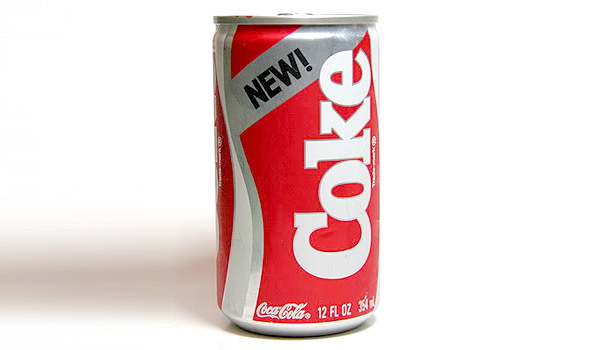
    New Coke


    In the early 80′s, the Coca-Cola Company faced a sobering fact. In most taste tests, people preferred Coke’s arch-rival Pepsi. Not one to be left in the dust, the makers of Coke decided to tinker with their classic recipe. The result was one of the greatest blunders in soft drink history (even bigger than Life Savers Cola): New Coke. Consumers were outraged and unanimously rejected the revision. Coke backpedaled and returned to the original recipe and forever branded it Coca-Cola Classic; a subtle reminder of the doomed derivative.

    Apple Lisa

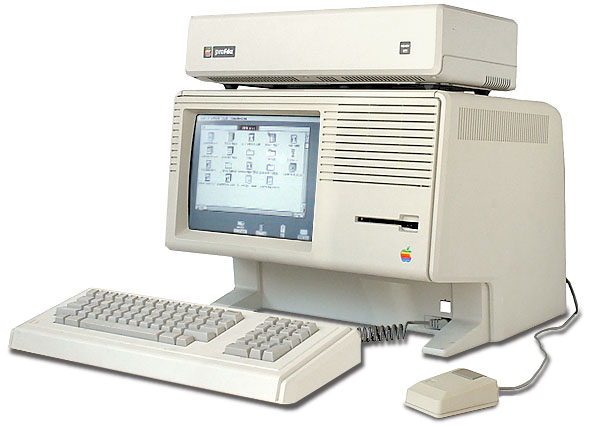
    It’s hard to imagine a time when Apple, Inc. wasn’t on the cutting edge of the tech world. But when the House that Jobs Built was in its toddler years, not every project was a homerun. Case in point: The Apple Lisa – the failed follow-up to the Apple II and III. The Lisa was a technical achievement, sporting the first ever GUI (graphical user interface aka pretty pictures on the screen) and a point-and-click device called a mouse. But with a $10,000 price tag, the bells and whistles just weren’t enough to entice consumers. Additional performance issues and pricey mandatory upgrades were the proverbial nail in the floppy drive; Lisa went the way of the dodo in 1985.

    Snuggie for Dogs

    Every now and then, an idea comes along that’s so profoundly dumb that it actually works. The original Snuggie worked. Snuggie for Dogs? Not so much. Nevermind the fact that animals really shouldn’t be wearing clothing to begin with (with one clear exception), but dogs are already pretty relaxed. This pointless product flopped hard, and dogs across the world celebrated by continuing to eat garbage and sniff butts.

    DeLorean DMC-12

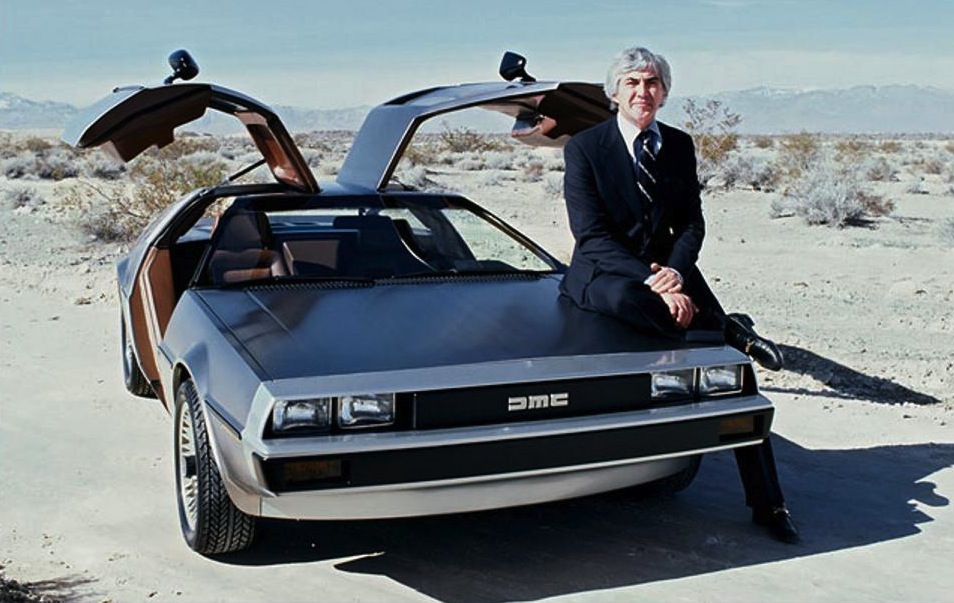
    Up until 1982, John DeLorean had an impressive resume. He’d developed the GTO, Grand Prix, and Firebird for Pontiac. He became a high level executive at General Motors. And he had just created his own venture: DeLorean Motor Company. But his flagship vehicle wasn’t as impressive as certain time travel movies may lead you to believe. The flashy DMC-12 paired low horsepower with a high price; its underperformance bankrupted DeLorean Motor Company and eventually destroyed the reputation and finances of its eponymous creator. Loans? Where you’re going you’re going to need…loans.

    Honegar

    The name says it all. Some genius thought a mashup of honey and apple cider vinegar would be a treat. To the surprise of exactly one guy, it wasn’t. Sure there’s evidence of the holistic benefits of both, but c’mon…Honegar just sounds gross.

    Nintendo Virtual Boy

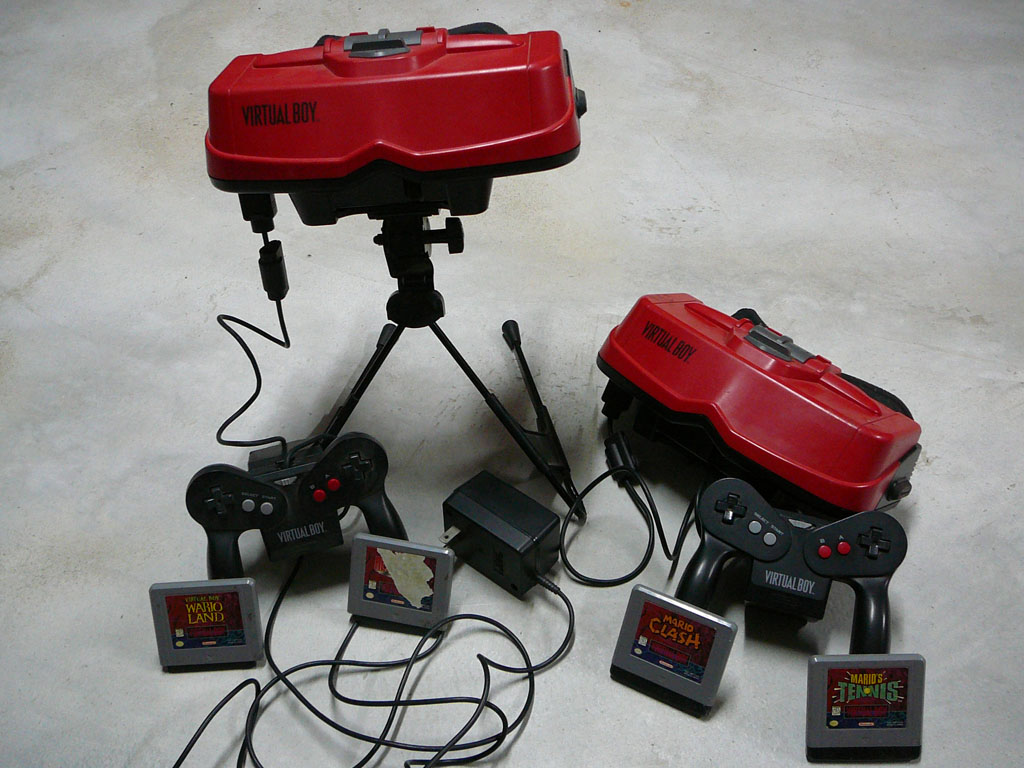
    You have to hand it to Nintendo – they’ve never been afraid to take risks. Who would have predicted the success of a bizarre gaming console named Wii that sported motion controls via a controller that resembles a TV remote and a nunchuk? The Virtual Boy was a wild idea that never panned out. Its nickelodeon-style goggle display was something out of a sci-fi movie. A b-movie perhaps. In fact, it was named one of the “Ugliest Products in Tech History” by PC World magazine. The graphics were rendered in a strange monochromatic red and few of the extremely limited number of games in its lackluster catalogue touted the much-hyped 3D effects Nintendo was going on about. In 1997, the Virtual Boy was virtually eradicated from stores across the US. If you have one, throw it up on eBay; it actually may have value as a collector’s item!

  • Fri, Apr 13 2012

    Below are the results from this week’s Brainstorm session, featuring the collaborative work of our designers, invention ambassadors, and community members (click either image for a larger version):

    Product 279: WorkBoost Paint Stilts

    Product 300: Key Hider

    The full feed for the brainstorm can be viewed here:


    That’s the recap! We’ll be posting a preview for next week’s brainstorm on Monday, but until then we’d love to hear your feedback on this week’s brainstorm and broadcast, so share and share alike in the comments. Change, as they say, is good.

  • Fri, Apr 13 2012

    Graze is moving into production! Our retailers are confident in the product. Take a look at it in the Upcoming Section and help us determine the price, by playing the Pricing Game.

    Congratulations to Abdullah Al-Harbi (Abdulla2022) and all of the 1,391 community members that helped influence the product!

  • Thu, Apr 12 2012

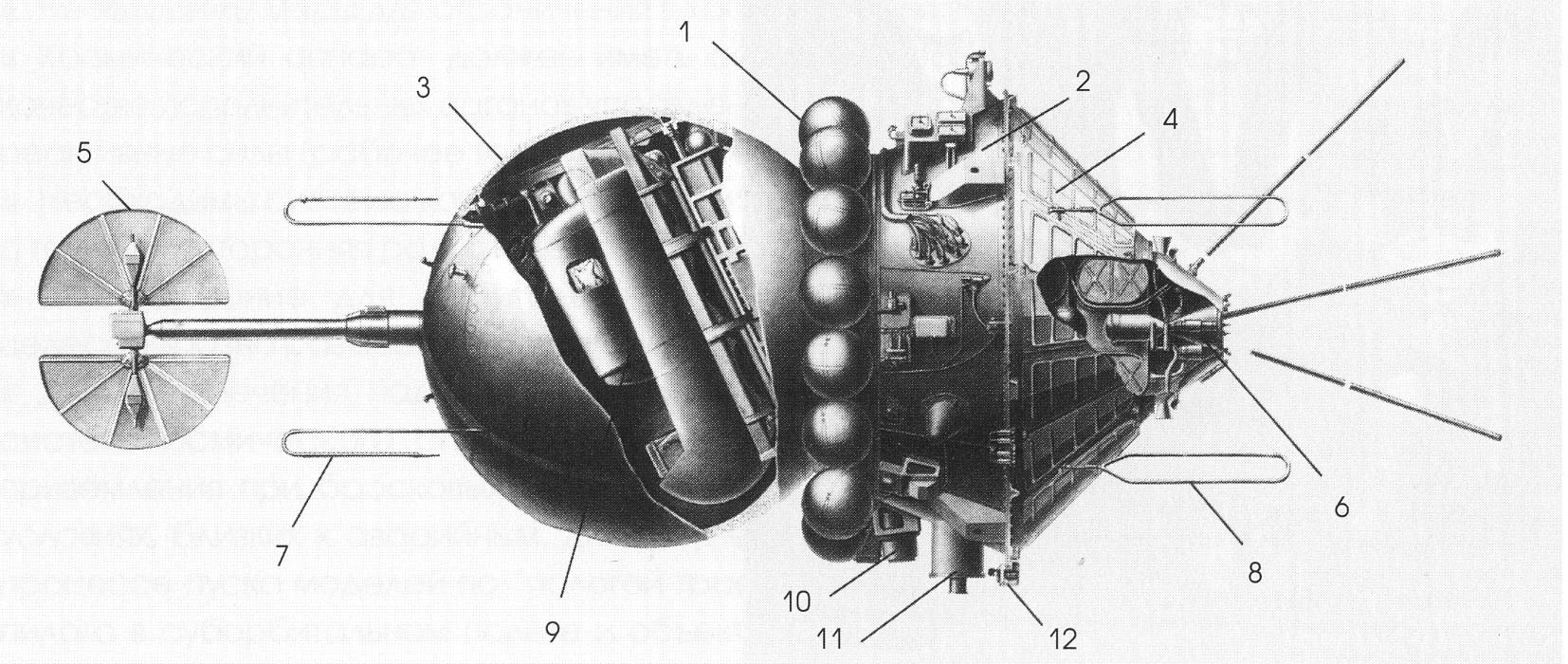
    51 years ago today, blasting off from a Russian launch site deep in the steppes of Kazakhstan, a Soviet pilot named Yuri Gagarin made history. Strapped into a cockpit no larger than a fighter jet’s, Gagarin became the first human to successfully reach outer space, completing a full orbit of Earth before coming down several hundred miles from his launch point. The vehicle that carried him on this incredible journey was Vostok 1, the brainchild of Russian rocket engineer Sergei Korolev and his team, and one of the most advanced pieces of tech at the time. The manned pod, only 2.3 meters wide, was attached to the end of a conical instrument module, which contained the fuel and propulsion system necessary to reach orbiting speed (like most spacecraft, the Vostok 1 required a booster rocket for launch, which was discarded once the craft exited the atmosphere). In honor of this little craft and its mighty achievement, here are seven neat facts you might not have known about Yuri’s high-tech ride:

    1. The Vostok 1 spacecraft, in its entirety, weighed 10,420 lb. The manned pod alone had a weight of 5,423 lb., one third of which was allocated to heat shielding.

    2. The speed reached by the Vostok propulsion system was 17,500 mph, the minimum velocity required to orbit the Earth. Moving at this speed (about 5 miles per second), Gagarin was able to complete a full orbit of the planet in less than an hour and a half.

    3. During development, the Vostok spacecraft was designed for use as both a manned spacecraft and an unmanned camera platform: the predecessor to the modern spy satellite. This dual functionality was important to gaining the Communist Party’s approval for the project, as they were keen on gaining a military advantage through the program.

    Yuri Gagarin, Vostok 1′s pilot and the first human to reach space.

    4. Because the engineers didn’t know how the human body would react to a zero-gravity environment, Vostok 1 was designed with a spherical shape to prevent its center of gravity from shifting. This assured relative comfort for the Cosmonaut inside, regardless of the craft’s orientation. The spherical shape of the pod also protected it from the enormous heat generated during reentry, allowing for maximum volume while minimizing surface area.

    5. Due to those same concerns about a Cosmonaut’s physical performance in zero-G, Vostok 1′s controls were also locked during flight. The craft’s trajectory was determined remotely by Soviet mission control, and Gagarin could only assume manual control after typing in a special code, written in an onboard envelope in case of emergencies (luckily, this function was never used).

    6. Because of the extreme stress that would be experienced by the craft during a mission, Vostok 1 was designed with only one window, a tiny circular portal about the width of a man’s face. Through this opening, Yuri Gagarin became the first man to view the planet Earth from space.

    7. While Vostok 1 was designed with a multitude of complex systems to keep Gagarin alive during orbit, the one thing it could not do successfully was land. Unlike later spacecraft, it was not fitted with thrusters to reduce its speed during re-entry, forcing Gagarin to eject at an altitude of 23,000 ft. and to descend to earth using a separate parachute. The Soviets decided to exclude this little detail from their press releases, which would later become the subject of controversy (the Fédération Aéronautique Internationale (FAI) required that both man and craft land together for a manned space mission to be officially recognized).

    The charred remains of the Vostok 1 capsule after landing, with the parachute still attached.

    Sources:
    Outer Space Universe
    Life’s Little Mysteries
    Space.com
    Wikipedia

  • Thu, Apr 12 2012

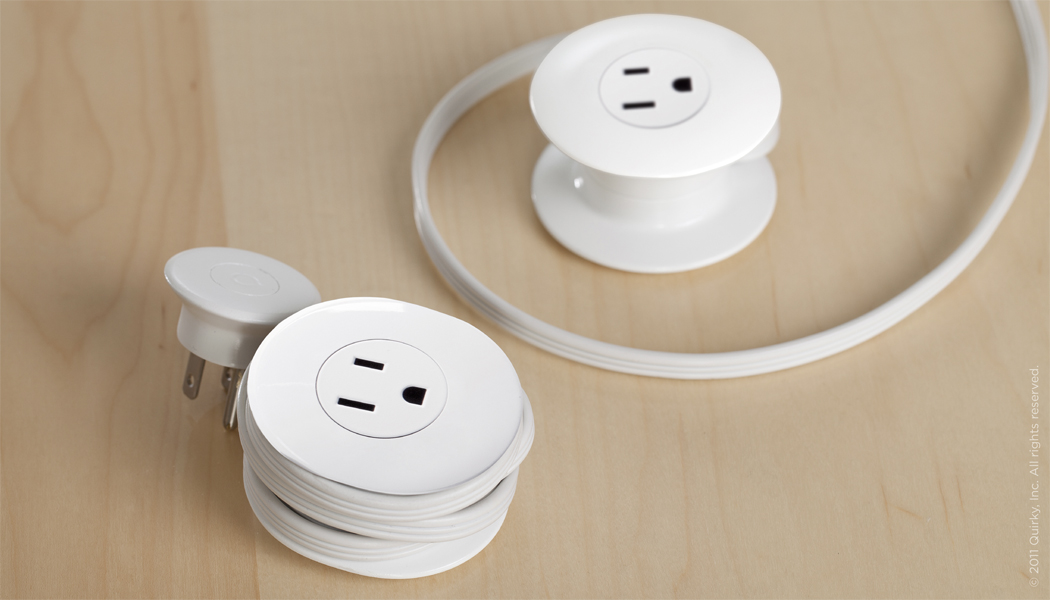
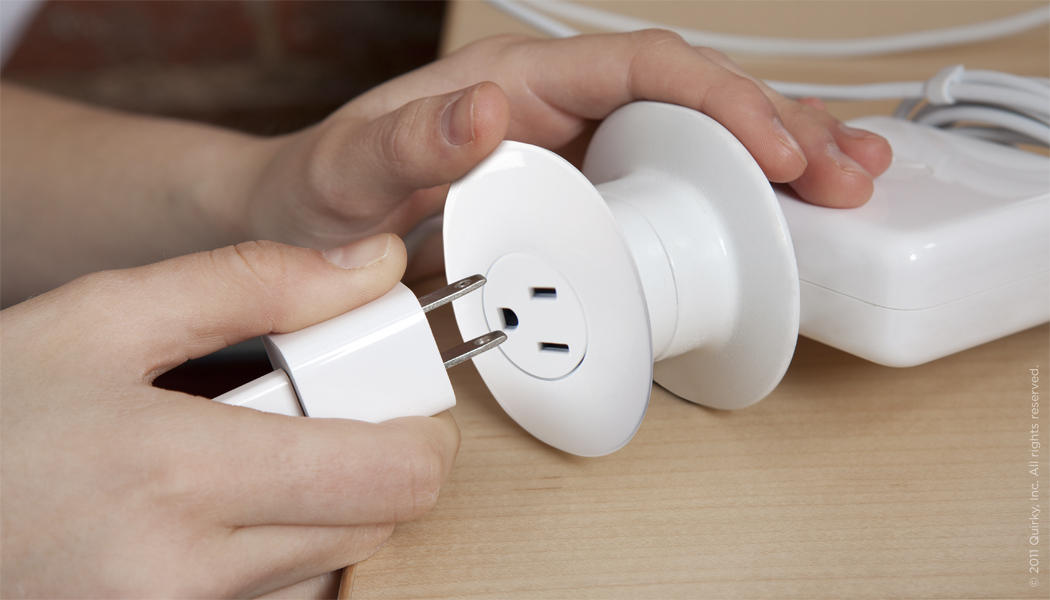
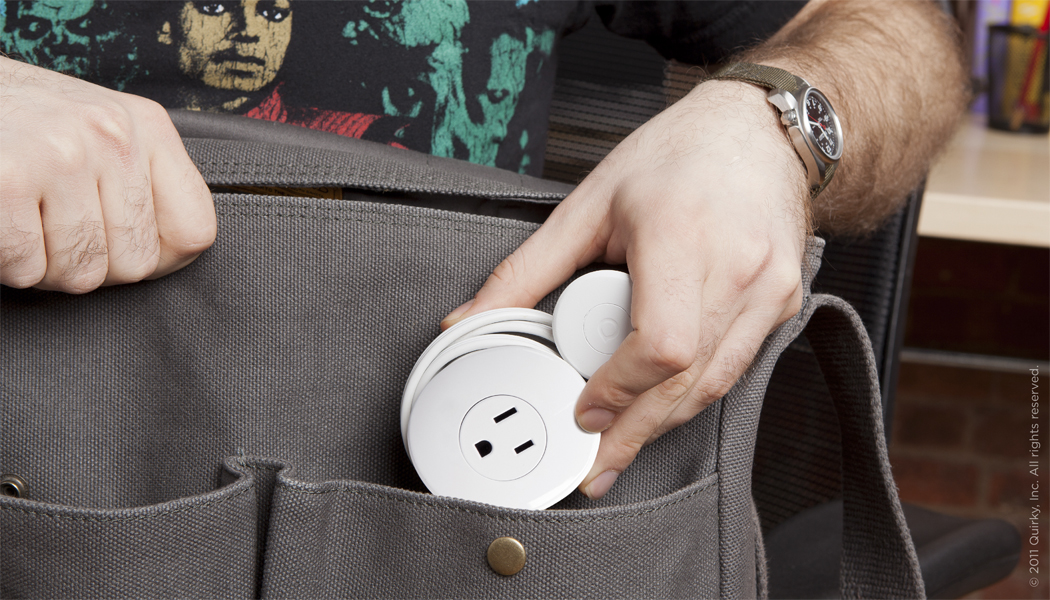
    Taunted by an outlet that’s just out of reach? Make it come to you with Port Power, a jolly little extension cord with cord management built it. Port Power come in two forms —one with a single outlet and one with two— but both feature spools that allow users to wrap excess cord around the extended outlet, keeping their space neat and organized. A clip holds the cord firmly in place so that Port Power can securely extend to any length. When not in use, this little bundle of convenience rolls up completely for compact storage.

    A veteran Quirky inventor, Mark Zech was tired of extension cords that looked more suited to a garage than a home. Thus, he set out on a (figurative) voyage to make an extension cord for the modern living room, and with 1550 influencers as his crew, discovered safe passage to a new land. That land was called Port Power, and it can be found in the Upcoming Section.

    Features:
    – 6 ft. extension cable
    – Integrated spool for cord management 
    – Single or double outlet extension 
    – Easy to store
    – Easy to place

    Materials:
    – Plastic

    Dimensions:
    – Single outlet: 73.5mm H x 73.5mm W x 47.5mm D
    – Double outlet: 73.5mm H x 65mm W x 47.5mm D

    Price, qty and features subject to change during production process

Page 3 of 129«12345»102030...Last »